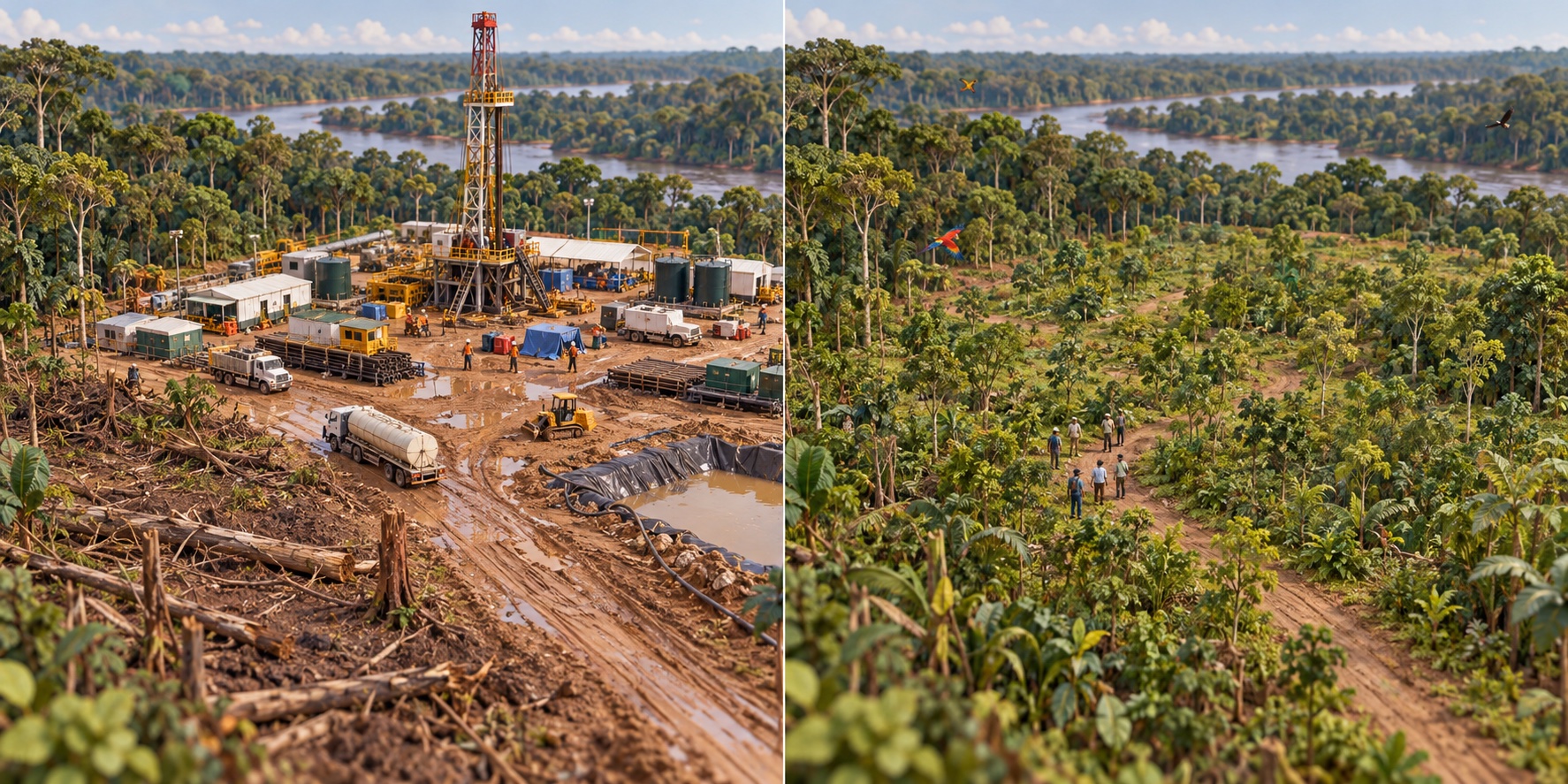
How the change works
- 01 / Public decision
Popular decision
- 02 / Physical change
Acts and implementation plan
- 03 / Possible outcome
Objective to be verified on the territory
A vote can set collective direction; implementing it requires acts, resources, deadlines, and public controls.
Research and local documents ↓What the evidence tells us
Ecuador's CNE announced 58.95% Yes and 41.05% No for the 2023 Yasuní consultation. The decision concerns keeping block 43's oil underground.
The result of the consultation
58.95 % of valid votesYes
41.05 % of valid votesNo
Final results announced by the CNE. The graph measures the vote, not the state of implementation.
Open the source ↗Read values and method
| Indicator | Value |
|---|---|
| Yes | 58.95 % of valid votes |
| No | 41.05 % of valid votes |
Final results announced by the CNE. The graph measures the vote, not the state of implementation.
Putting the choices into practice
Decision
The challengeResult of the vote
The responseDefined mandate
Implementation
The challengeObjective on paper
The responseActs, resources and deadlines
Verification
The challengePresumed success
The responsePublic progress reports
The diagram compares choices and conditions for putting them into practice. Measured outcomes and their limits are discussed in the evidence.
Research and local documents ↓Conditions and limits
The result of the referendum does not prove that all the wells are closed or the restoration is complete. The second scene represents the objective to be implemented.
Other possible benefits
Democratic participation and accountability for following up on decisions.
Research and local documents
- Local project or policy documentConsejo Nacional Electoral · final results of the Yasuní referendum ↗
Institutional documentation of the program, territory or rules mentioned.
- Local project or policy documentConstitutional Court of Ecuador · Opinion 6-22-CP/23 ↗
Institutional documentation of the program, territory or rules mentioned.