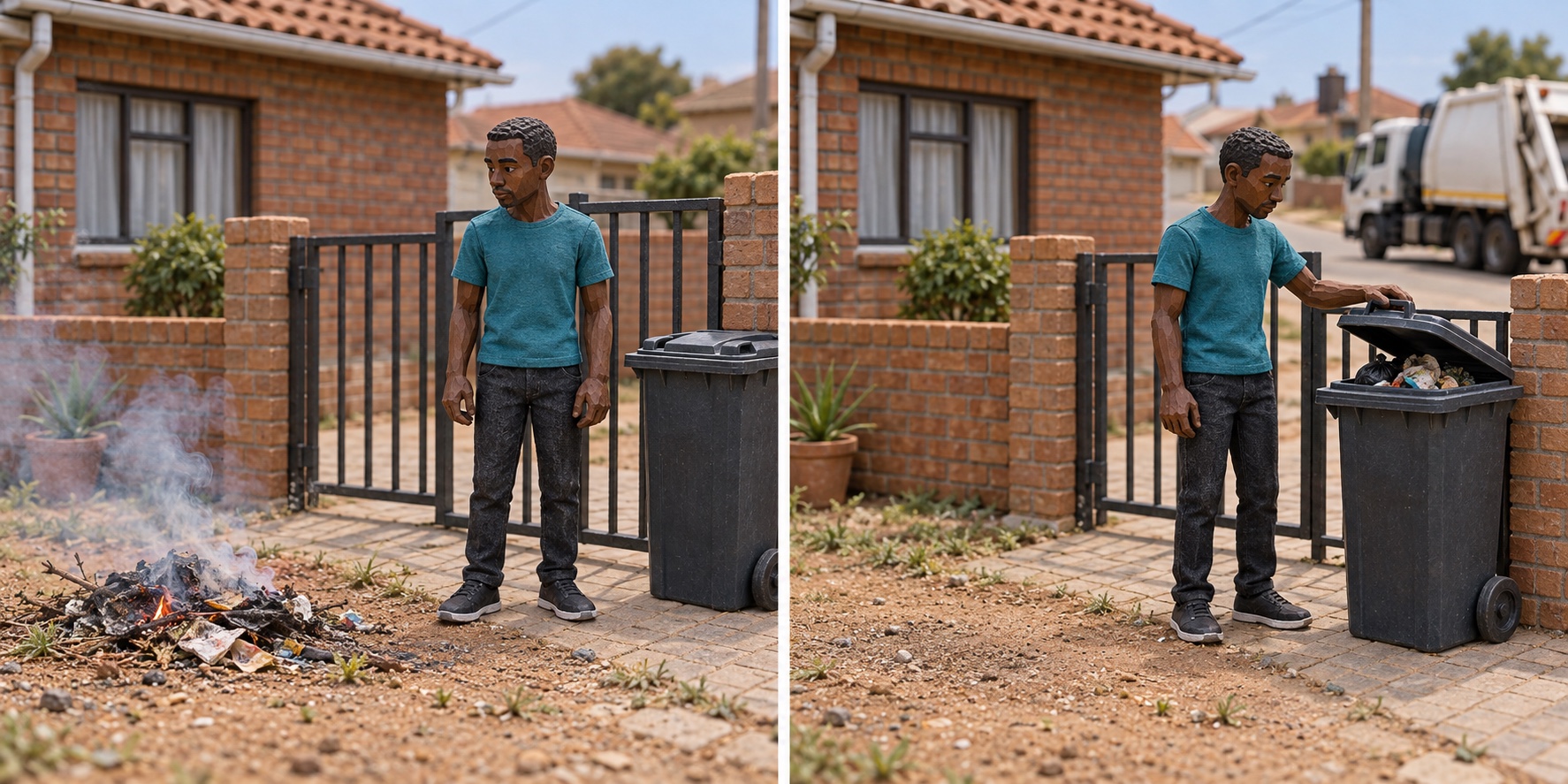
Use available collection instead of burning waste
Why this can help
Open burning of household waste releases particles and gases. South African waste experiments measured these emissions. Using suitable collection for waste that would otherwise be burned removes that local combustion source.
One possible next step
Find an available collection service that accepts your household waste and check how to prepare it. Use that route for waste you would otherwise burn, and check that it is not simply burned elsewhere.
What changes the outcome
An accessible collection or drop-off route must exist and accept this waste without open burning. Missing services are not an individual failing. Follow local rules for hazardous waste; do not stockpile unsafely or dump it. Collection, treatment and climate impacts are outside this comparison.
Your illustrative scenario
Over one year · with the assumptions below
You
120 kg of waste openly burned less
You + 10 friends
1,320 kg of waste openly burned less
1,000 participants
120,000 kg of waste openly burned less
These are scenarios, not measured personal or collective savings. One separate household per participant. People sharing a home count it once, not once each.
Your inputs
- Waste previously burned per comparable collection period
- 5 kg
- Waste still openly burned in the same period
- 0 kg
- Comparable collection periods per year
- 24
Calculation of the difference: (5 − 0) kg × 24 = 120 kg of waste openly burned
Calculation boundaries
Mass of comparable household waste no longer openly burned, where it genuinely reaches an available appropriate service. Use previous records; never burn waste to measure a baseline. Compare similar material and moisture, include remaining burning and check that collection does not simply move the open fire elsewhere. This is not recycled mass or an emission estimate.
5 kg before, 0 kg after and 24 periods are editable illustrations, not measured Zamdela household values. Zero after assumes that the entire counted waste stream reaches suitable collection without open burning. Enter the actual residual amount.
Sources and calculation references
- Characterization of gas and particle emissions from open burning of household solid waste from South AfricaXiaoliang Wang et al. · 2023
Read the method: universalizable.com/en/method/ · One sheet · print double-sided, long-edge binding