
Keep suitable produce in an evaporative cooler
Why this can help
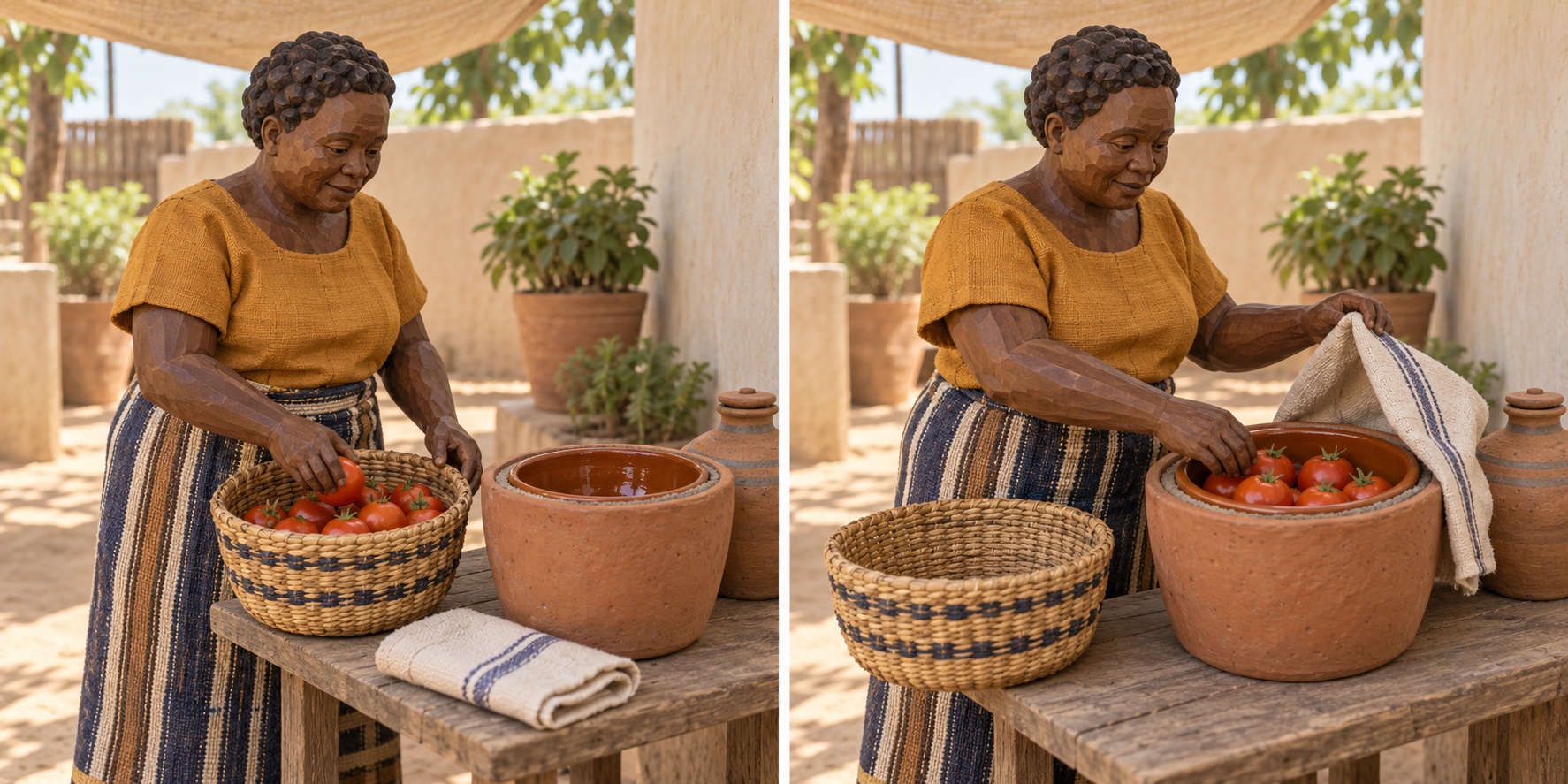
An existing clay-pot cooler can help suitable produce last longer in hot, dry conditions. Research in Burkina Faso and Rwanda measured cooling; shelf-life tests in Rwanda found benefits for some produce. Less spoilage matters when more of that food is actually eaten.
One possible next step
Check whether the weather is hot and dry and the existing cooler suits your vegetables. Follow its cleaning and water guidance, and plan to eat the produce before it spoils. Keep foods requiring refrigeration in the fridge.
What changes the outcome
Use a suitable, clean device with water, shade and airflow available. Humid weather and mould can defeat the benefit. This does not replace a refrigerator for meat, dairy, medicines or foods requiring refrigeration. An unpowered basket baseline gives no electricity saving.
Your illustrative scenario
Over one year · with the assumptions below
You
8 kg of edible food wasted less
You + 10 friends
88 kg of edible food wasted less
1,000 participants
8,000 kg of edible food wasted less
These are scenarios, not measured personal or collective savings. One separate household per participant. People sharing a home count it once, not once each.
Your inputs
- Edible produce lost per comparable batch before
- 0.4 kg
- Edible produce still lost per comparable batch
- 0.2 kg
- Comparable batches in suitable conditions per year
- 40
Calculation of the difference: (0.4 − 0.2) kg × 40 = 8 kg of edible food wasted
Calculation boundaries
Avoidable spoilage of equal incoming quantities of the same produce at similar ripeness, followed until eaten or discarded. Credit only food actually eaten instead of lost; longer shelf life or retained water alone is not avoided food waste. Match weather and handling. Added water, device materials and their impacts are outside this food-mass comparison.
0.4 kg before, 0.2 kg after and 40 batches are hypothetical inputs, not the report’s loss rates. Enter comparable observations and keep all uneaten spoilage in the after value. The model does not predict preservation time or food safety.
Sources and calculation references
- Evaporative Cooling for Improved Fruit and Vegetable Storage in Rwanda and Burkina FasoEric Verploegen, Rashmi Ekka and Gurbinder Gill; MIT D-Lab and Agribusiness Associates, with UC Davis Horticulture Innovation Lab · 2019
- Evaporative Cooling Best Practices GuideEric Verploegen, Peter Rinker and Kukom Edoh Ognakossan; MIT D-Lab, World Vegetable Center and Movement e.V. · 2018
Read the method: universalizable.com/en/method/ · One sheet · print double-sided, long-edge binding