

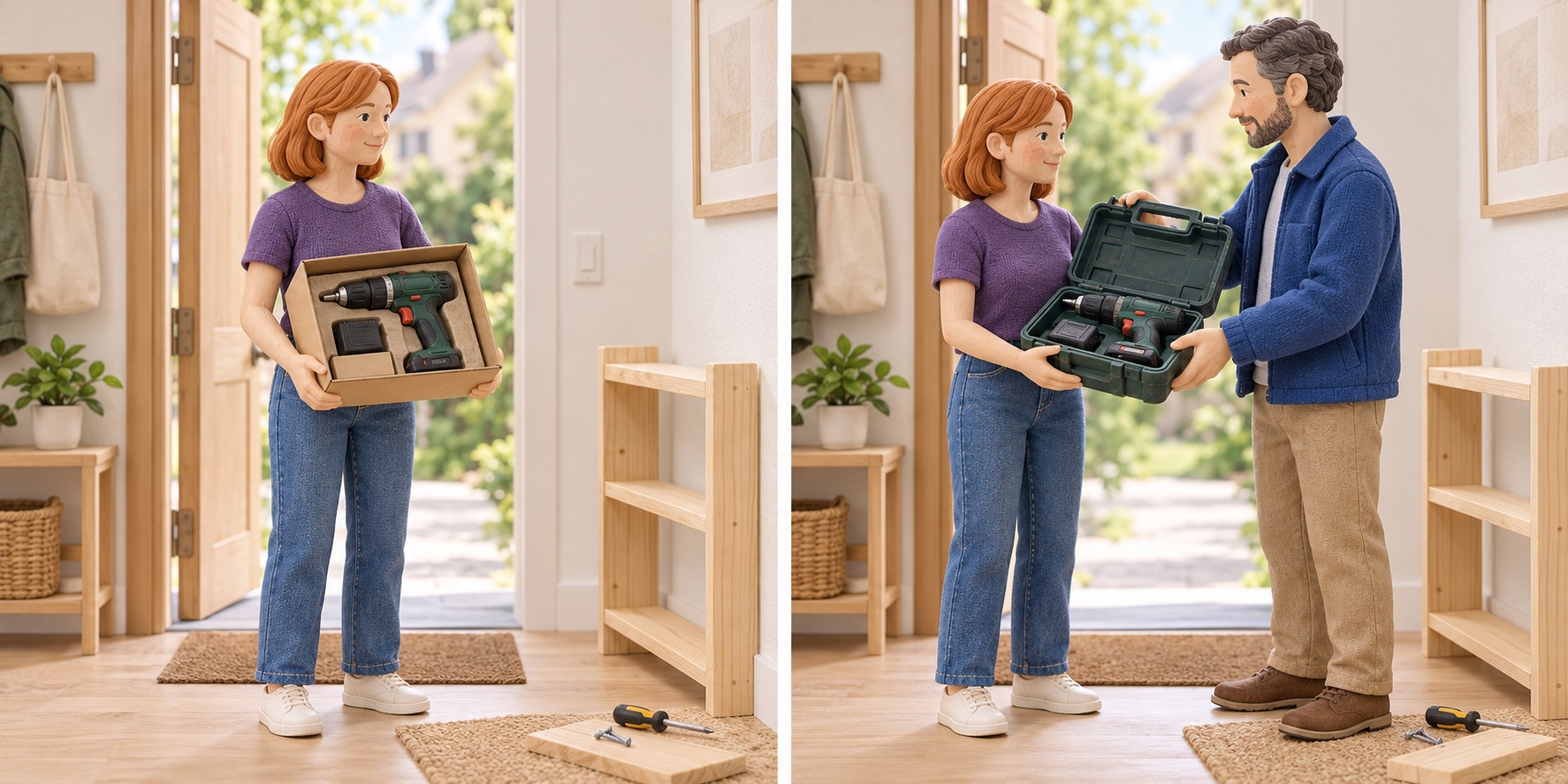
Borrow a tool you rarely need
Why this can help
Borrowing an existing tool can replace a new purchase. Count purchases genuinely avoided, rather than every loan.
One possible next step
Before buying a tool for one job, check whether a neighbour or lending service has a suitable one; agree on safe use and return.
What changes the outcome
The result counts new tools, not carbon savings. Include any new tools still bought, including replacements caused by extra wear. Travel, maintenance and shared-service capacity affect the wider environmental result. Count each avoided purchase once.
Your illustrative scenario
Over one year · with the assumptions below
You
1 new tools purchased less
You + 10 friends
11 new tools purchased less
1,000 participants
1,000 new tools purchased less
These are scenarios, not measured personal or collective savings. One separate household per participant. People sharing a home count it once, not once each.
Your inputs
- New tools you would buy this year
- 1
- New tools still needed with borrowing
- 0
Calculation of the difference: 1 − 0 = 1 new tools purchased
Calculation boundaries
New tools acquired for the same jobs in one year. Count only purchases genuinely replaced; a loan is not automatically an avoided purchase. Include any new tools needed for sharing and count each shared acquisition once. Do not claim the same foregone purchase again in future years. No carbon or material-mass conversion.
One actual intended new-tool purchase is replaced by a local loan this year, with no new tool needed to provide the loan. These are editable assumptions, not an observed average.
Sources and calculation references
- Think Green Before You Shop (Text Only)U.S. Environmental Protection Agency · 2025
- Environmental impacts and potential of the sharing economyJohn Magne Skjelvik, Anne Maren Erlandsen and Oscar Haavardsholm; Nordic Council of Ministers · 2017
Read the method: universalizable.com/en/method/ · One sheet · print double-sided, long-edge binding