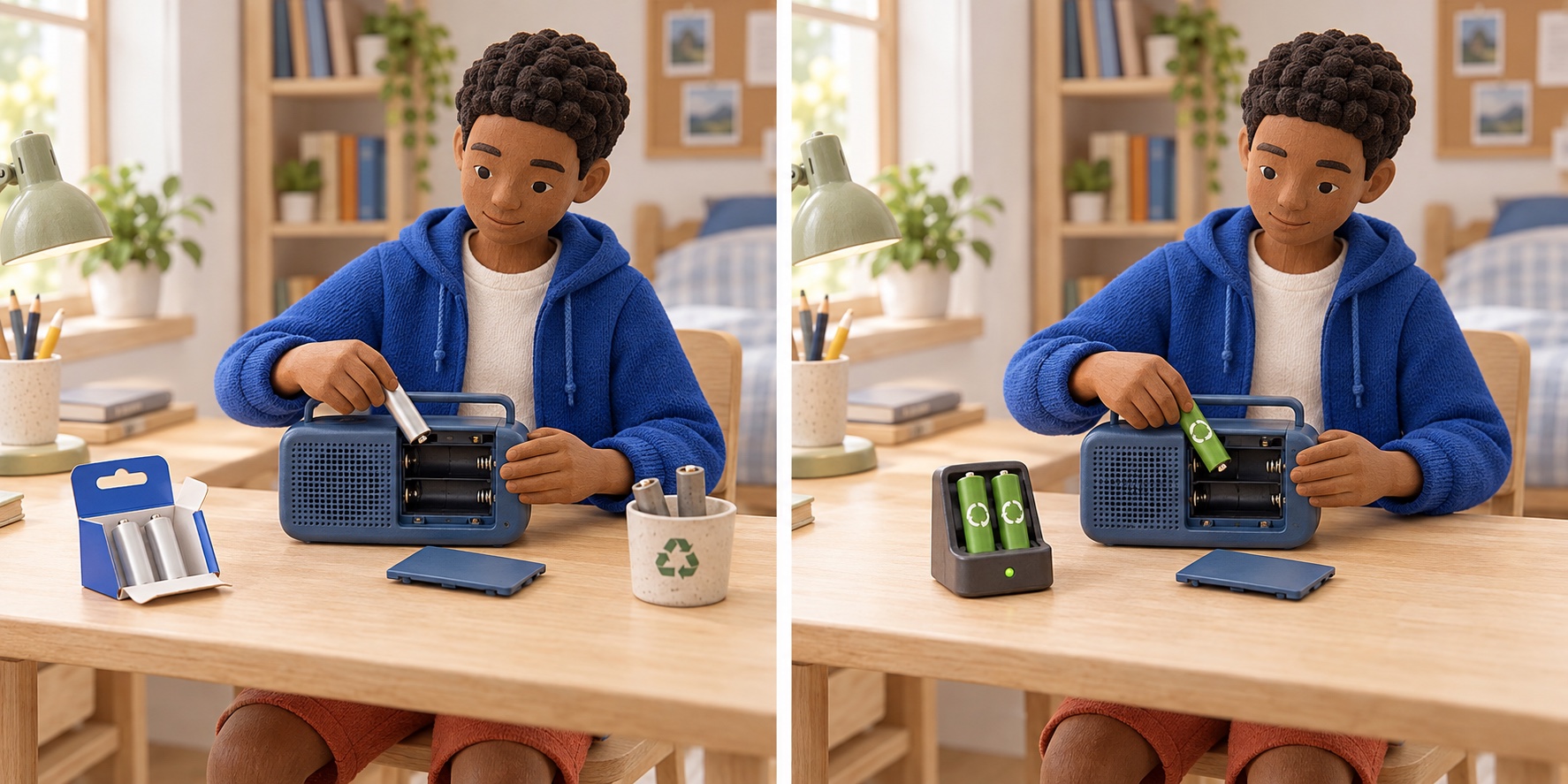
Reuse rechargeable batteries in suitable devices
Why this can help
Repeatedly using rechargeable cells can reduce the number of new battery cells needed for the same use. Compatibility and actual reuse matter.
One possible next step
Check one frequently used device’s manual for rechargeable-cell compatibility, then choose the correct cells and charger. Never recharge disposable batteries.
What changes the outcome
This is a cell count, not an energy or carbon saving. Include newly bought rechargeable cells and any remaining disposables. Production, charging and lifetime affect the wider result; few reuses may worsen some impacts. Never recharge disposable cells.
Your illustrative scenario
Over one year · with the assumptions below
You
22 new battery cells acquired less
You + 10 friends
242 new battery cells acquired less
1,000 participants
22,000 new battery cells acquired less
These are scenarios, not measured personal or collective savings. One separate device or device group per participant. A shared object is counted once.
Your inputs
- Disposable cells without rechargeables per year
- 24
- Disposable cells still needed per year
- 0
- New rechargeable cells acquired this year
- 2
Calculation of the difference: 24 − (0 + 2) = 22 new battery cells acquired
Calculation boundaries
New battery cells acquired for equivalent service from the same compatible device in one year. Include remaining disposables and all newly bought rechargeable cells. Objects are counted, not equal mass or capacity. Charger production, charging electricity and disposal are not quantified; update purchases each year rather than assuming a guaranteed battery lifetime.
An editable example: an existing device would need 24 disposable cells this year; the same service uses two newly acquired rechargeable cells and no disposables. This does not assume one recharge equals one disposable-cell lifetime.
Sources and calculation references
- Batterien und Akkus richtig nutzen und fachgerecht entsorgenUmweltbundesamt — German Environment Agency · 2024
- Life cycle assessment of consumption choices: a comparison between disposable and rechargeable household batteriesGiovanni Dolci, Camilla Tua, Mario Grosso and Lucia Rigamonti · 2016
Read the method: universalizable.com/en/method/ · One sheet · print double-sided, long-edge binding