
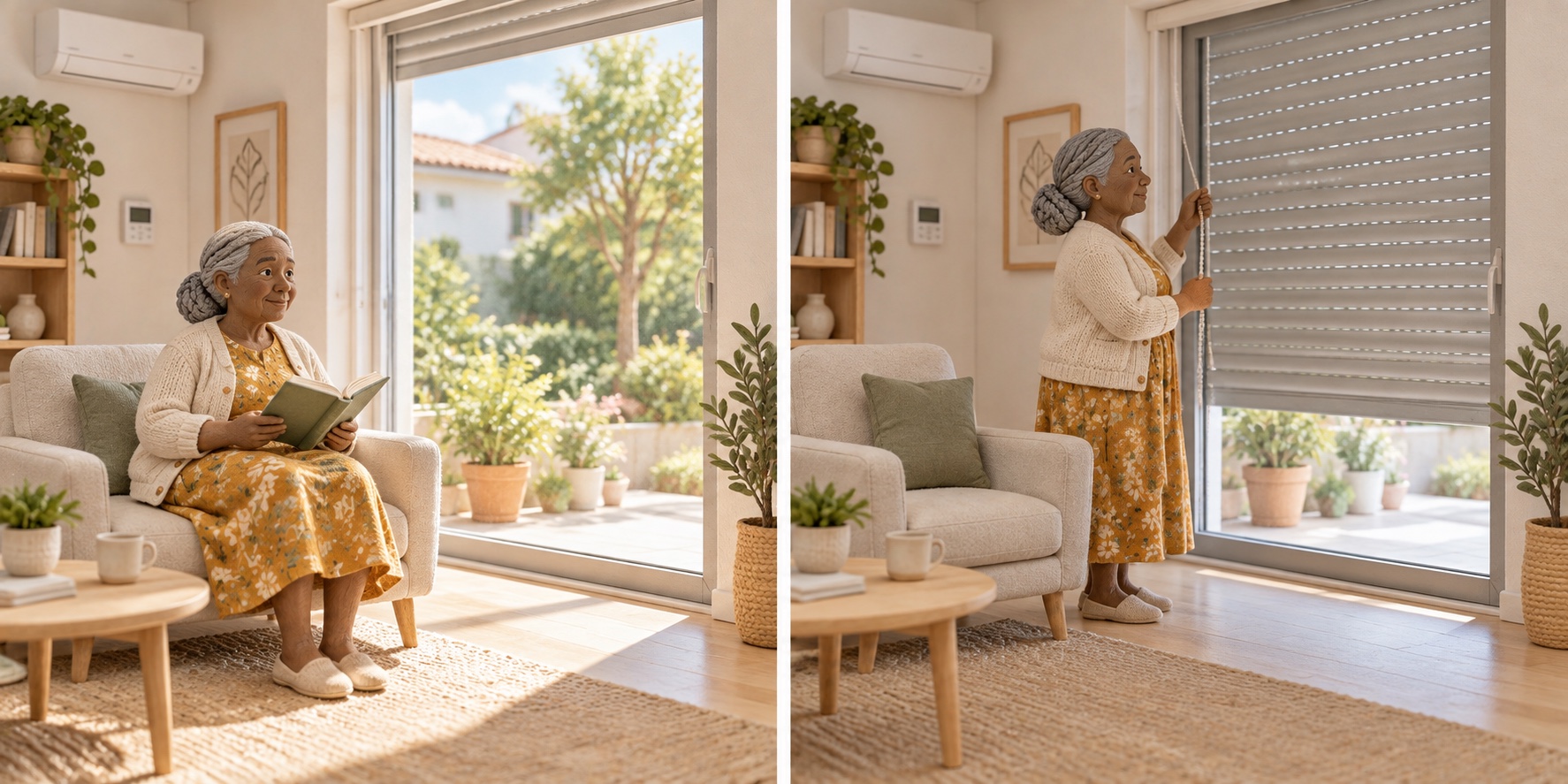
Shade sunny windows before the room heats up
Why this can help
Blocking unwanted sunlight can reduce heat entering through windows and the cooling needed to maintain comfort. The effect depends on the window, shading, weather and how cooling is operated.
One possible next step
On a warm sunny day, adjust an existing shutter or shade before direct sun heats the room, keeping useful daylight and necessary cooling.
What changes the outcome
No fixed saving applies to every home. Compare cooling electricity under comparable weather, occupancy and comfort; include any extra lighting. In cold weather, blocking useful sun can increase heating demand.
Your illustrative scenario
Over one year · with the assumptions below
You
60 kilowatt-hours of electricity less
You + 10 friends
660 kilowatt-hours of electricity less
1,000 participants
60,000 kilowatt-hours of electricity less
These are scenarios, not measured personal or collective savings. One separate household per participant. People sharing a home count it once, not once each.
Your inputs
- Cooling electricity per comparable day before
- 6 kWh
- Cooling electricity per comparable day after
- 5 kWh
- Suitable comparable days per year
- 60
Calculation of the difference: (6 − 5) kWh × 60 = 60 kilowatt-hours of electricity
Calculation boundaries
Cooling electricity for the same home over complete comparable days: match weather, temperature setpoint, occupancy and comfort. Include extra lighting or ventilation fans. Unmatched meter readings do not establish an effect of this action; maintain necessary cooling.
6 kWh before, 5 kWh after and 60 suitable days are hypothetical example inputs, not study results or a typical shading saving. Enter a locally assessed or appropriately measured comparison; no fixed percentage is applied.
Sources and calculation references
- Office Energy ChecklistU.S. Department of Energy, Federal Energy Management Program
- WindowsAustralian Government, Department of Climate Change, Energy, the Environment and Water
- ShadingAustralian Government, Your Home; Caitlin McGee, updated by Chris Reardon · 2013
Read the method: universalizable.com/en/method/ · One sheet · print double-sided, long-edge binding