Print needed documents on both sides
Why this can help
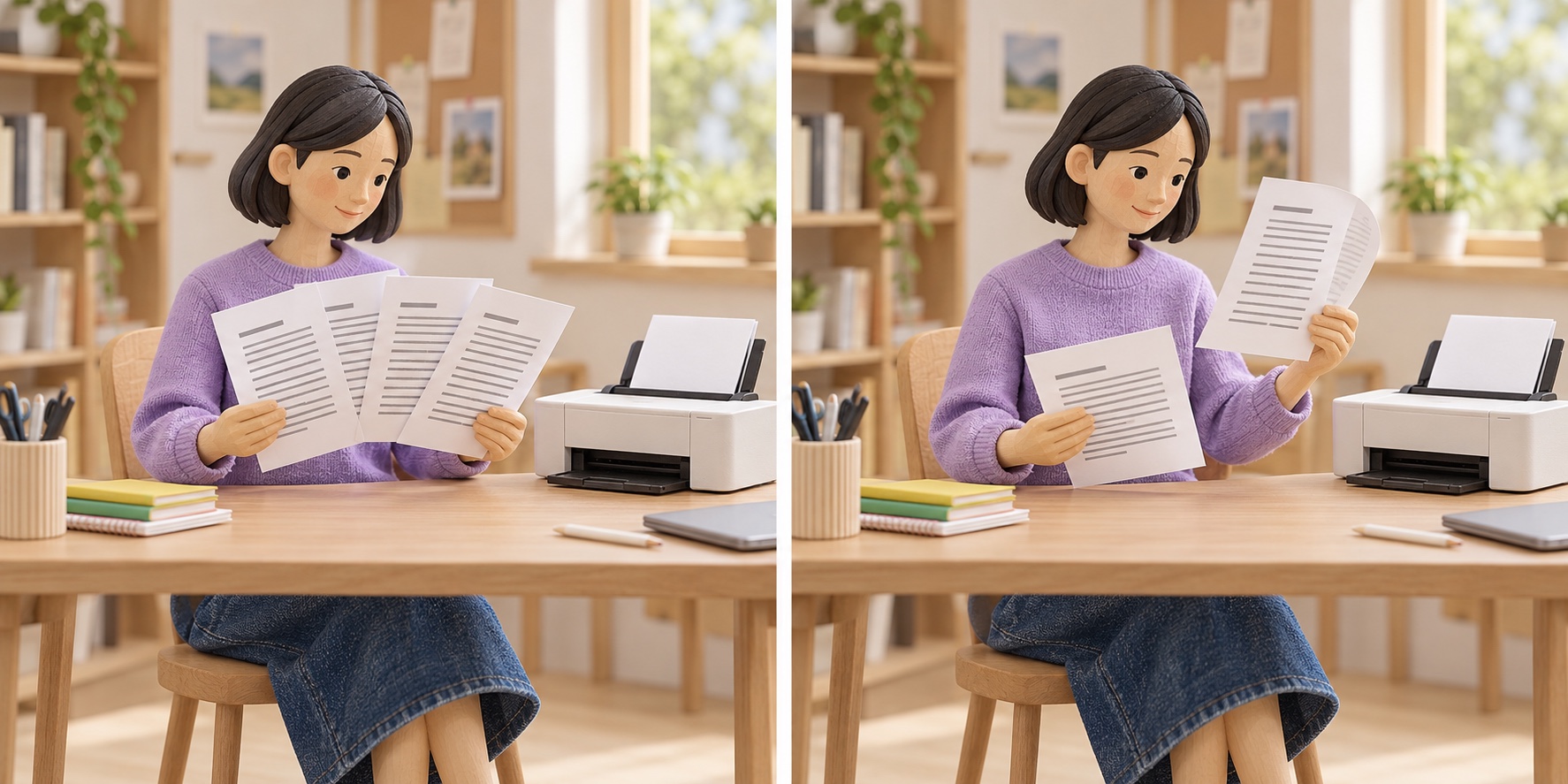
Printing both sides reduces the sheets needed for a suitable document. Set duplex printing as the default and check the preview, using a printer you already have.
One possible next step
Open one needed multi-page document, select double-sided printing and check the preview before printing.
What changes the outcome
An odd final page still needs a sheet; a one-page document saves none. Count mistakes and reprints separately. Fewer sheets do not imply the same percentage reduction in ink, electricity or emissions.
Your illustrative scenario
Over one year · with the assumptions below
You
520 paper sheets used less
You + 10 friends
5,720 paper sheets used less
1,000 participants
520,000 paper sheets used less
Each participant repeats your scenario. This is hypothetical participation, not measured collective savings.
Your inputs
- Pages in each document
- 4
- Documents per week
- 5
- Weeks per year
- 52
Calculation of the difference: (4 − ceil(4/2)) × 5 × 52 = 520 paper sheets used
Calculation boundaries
Paper sheets for the same necessary documents, with one page per side and unchanged readability. Round up the last double-sided sheet. Printer operation, ink, paper production and disposal are outside this count.
Four pages, five documents per week and 52 weeks are example assumptions. The sheet count follows the print layout; it is not a measured average or a carbon estimate.
Sources and calculation references
- The Benefits of Automatic DuplexingU.S. Environmental Protection Agency, Federal Electronics Challenge · 2013
- Increasing duplex printing among the federal workforceU.S. General Services Administration, Office of Evaluation Sciences · 2015
Read the method: universalizable.com/en/method/ · One sheet · print double-sided, long-edge binding