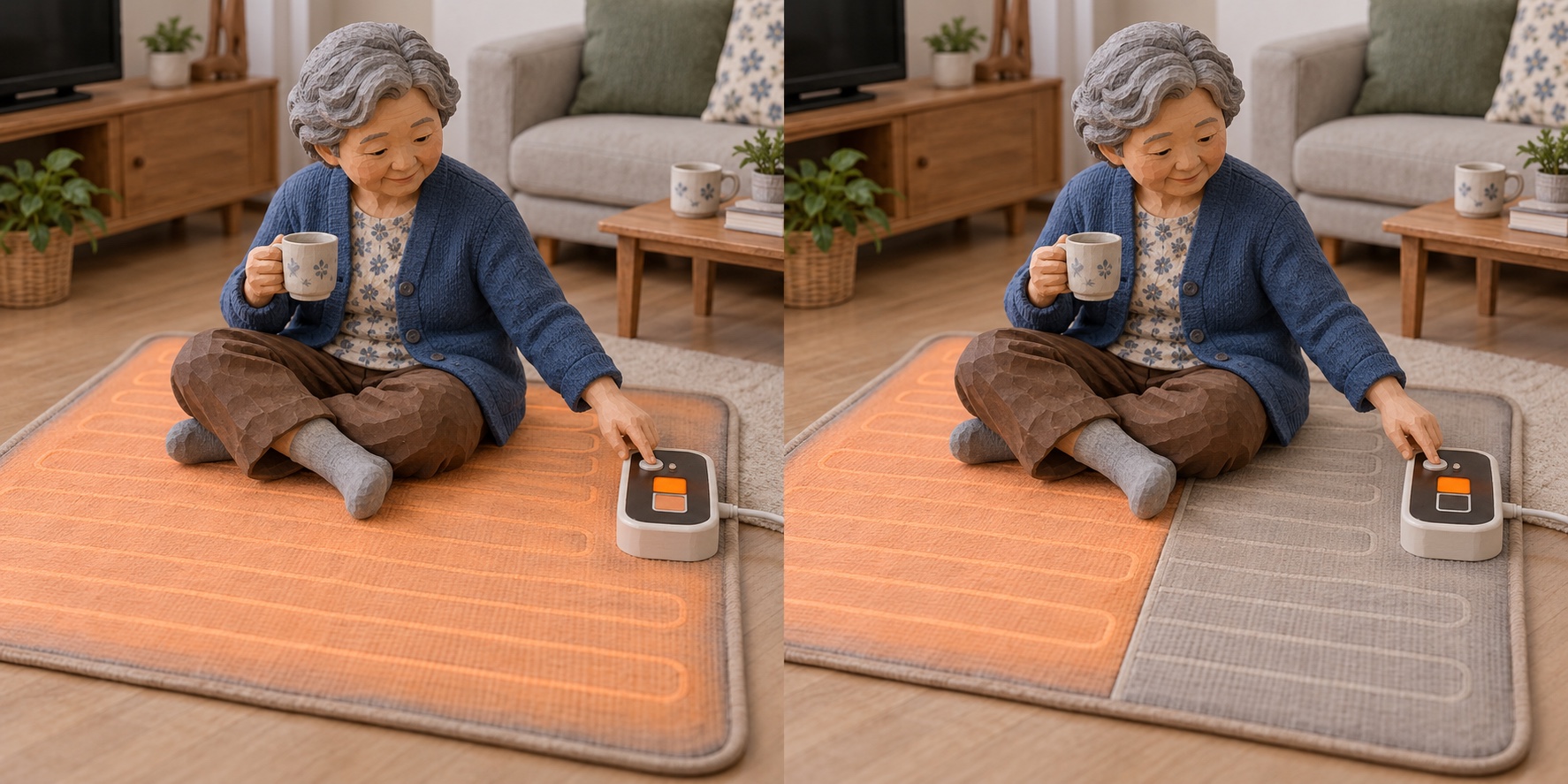
Use only the electric-mat warmth you need
Why this can help
A suitable lower setting or smaller heated zone can reduce an electric mat’s energy use. Japanese guidance documents this appliance-specific opportunity.
One possible next step
Check whether the existing mat supports a comfortable lower setting or separately controlled zones.
What changes the outcome
Use only the controls and coverings allowed by the manufacturer. This does not establish that an electric mat always outperforms central heating, and personal comfort needs differ.
Your illustrative scenario
Over one year · with the assumptions below
You
20 kilowatt-hours of electricity less
You + 10 friends
220 kilowatt-hours of electricity less
1,000 participants
20,000 kilowatt-hours of electricity less
These are scenarios, not measured personal or collective savings. One separate household per participant. People sharing a home count it once, not once each.
Your inputs
- Electricity over a complete comparable day Before
- 1 kWh
- Electricity over a complete comparable day After
- 0.9 kWh
- Comparable days per year
- 200
Calculation of the difference: (1 − 0.9) × 200 = 20 kilowatt-hours of electricity
Calculation boundaries
Compare the same appliance service and a complete cycle, including any extra cooling, reheating, spinning or finishing. Only electricity is counted, not manufacture or carbon emissions. Match ambient temperature, use and comfort; otherwise meter differences cannot be attributed to this change. Use only the controls and coverings allowed by the manufacturer. This does not establish that an electric mat always outperforms central heating, and personal comfort needs differ.
The initial values are editable arithmetic examples, not measurements or typical savings from the cited studies. Replace them with comparable readings for your situation. The sources support the mechanism and its conditions; they do not predict these numbers.
Sources and calculation references
Read the method: universalizable.com/en/method/ · One sheet · print double-sided, long-edge binding