New action
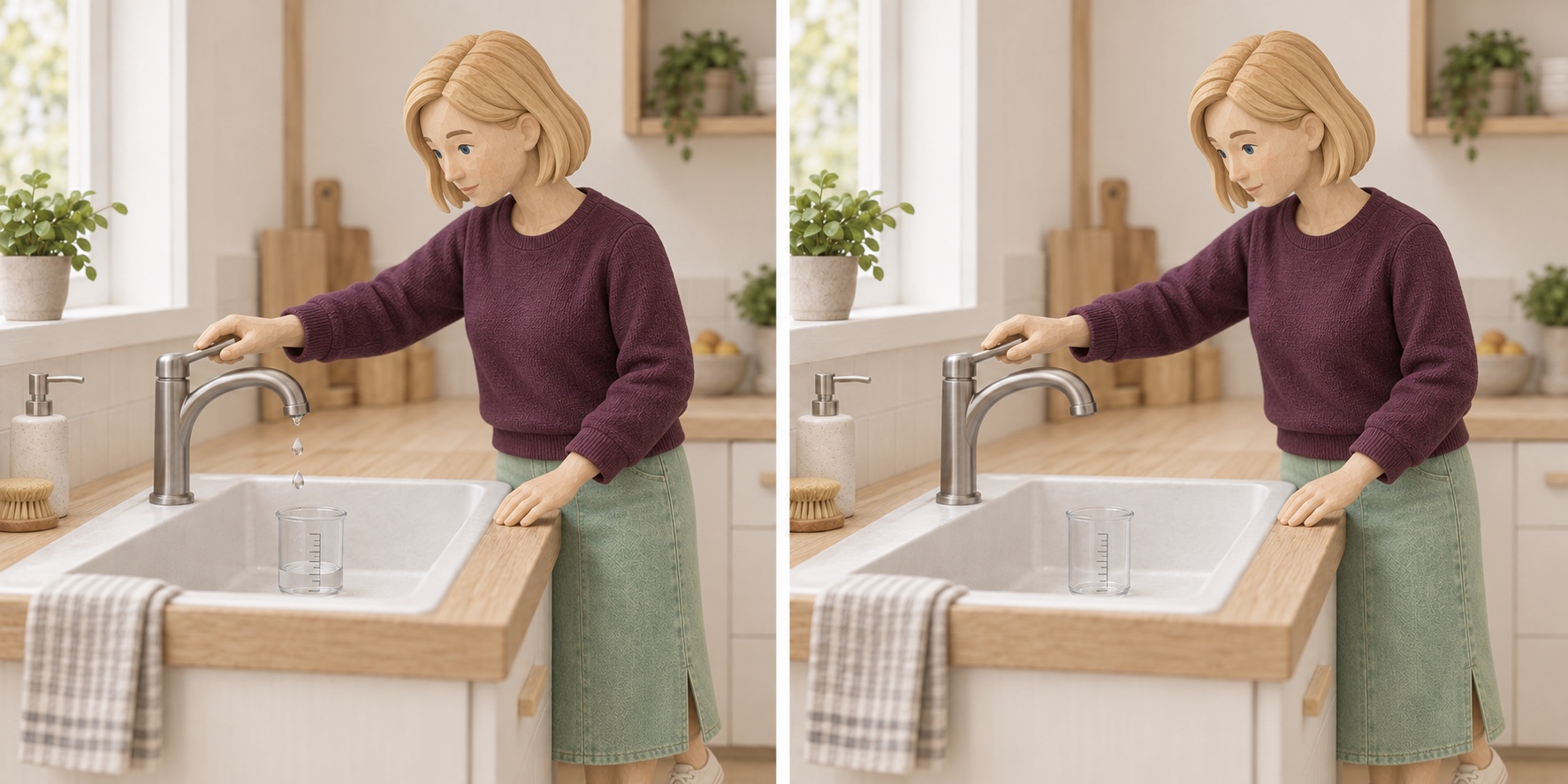
Repair a measurable leak
Repairing a persistent leak avoids water that serves no useful purpose.
Your scenario, drawn
A small leak keeps accumulating
Lines assume constant rates. Their separation is the cumulative difference, not observed history.
Water volume only. Water heating and water-supply emissions are excluded.
Sources and scope ↗Read the values
| Before | 5,256 L |
|---|---|
| After | 0 L |
| Annual difference | 5,256 L |
What changes the result +
EPA WaterSense recommends checking taps, fittings and meters. Measure collected millilitres over a known time before and after repair. The scenario assumes the measured leak continues for the stated days; irregular leaks need repeated measurements.
With the tap fully closed, collect the leak for a timed interval and measure the volume. Repeat after repair or ask the person responsible for maintenance.
03 / Sources and scope
Documented mechanism
What the evidence supports
Repairing a persistent leak avoids water that serves no useful purpose. EPA WaterSense recommends checking taps, fittings and meters.
Boundary of the claim
Measure collected millilitres over a known time before and after repair. The scenario assumes the measured leak continues for the stated days; irregular leaks need repeated measurements.
- Fix a Leak Week
Consulted section (original language): Checking for leaks; faucet leaks
Consultation: Webpage / full text
Sources reviewed: