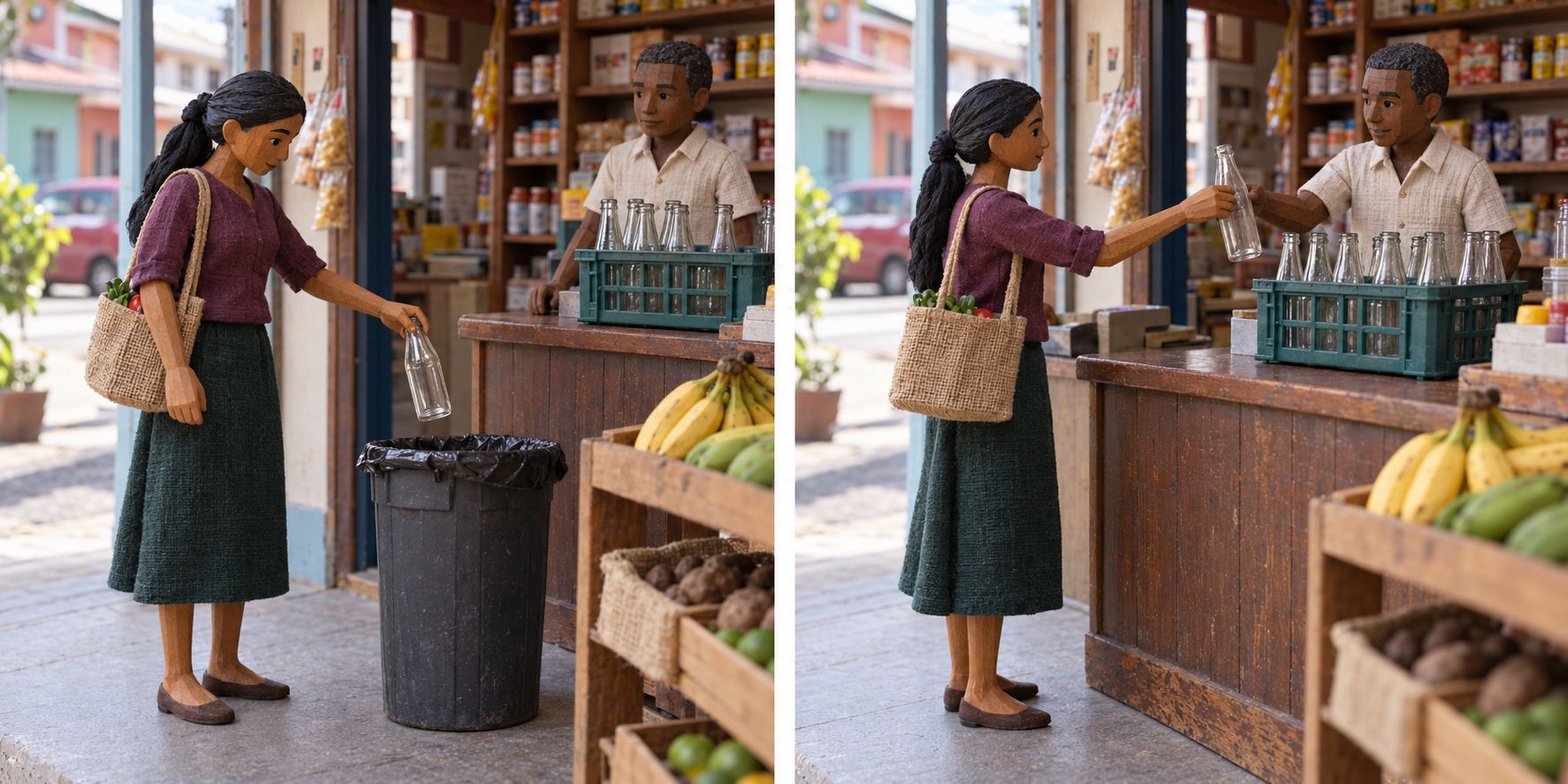
Return the bottle to a system that refills it
Why this can help
Returning an accepted refillable bottle allows it to serve again. Lifecycle studies support benefits over comparable single-use glass in suitable local systems. Caribbean return networks provide a place for this gesture, including bottles for non-alcoholic drinks.
One possible next step
Ask the usual shop which bottles are refilled, and bring those empties on your next visit.
What changes the outcome
Check that the bottle is refilled, not merely collected for recycling. Washing, transport, breakage and reuse cycles determine the environmental result; foreign studies are not a local carbon factor. Return intact accepted empties on a trip already planned. Do not buy extra drinks or make a dedicated drive. The calculator counts returns, not avoided production.
Your illustrative scenario
Over one year · with the assumptions below
You
120 refillable bottles returned more
You + 10 friends
1,320 refillable bottles returned more
1,000 participants
120,000 refillable bottles returned more
These are scenarios, not measured personal or collective savings. One separate household per participant. People sharing a home count it once, not once each.
Your inputs
- Accepted refillable empties returned per week before
- 0
- Accepted refillable empties returned per week after
- 3
- Comparable weeks per year
- 40
Calculation of the difference: (3 − 0) bottle returns × 40 = 120 refillable bottles returned
Calculation boundaries
The same beverage consumption and accepted refillable bottles before and after. The difference counts additional intact empties returned to the refill operator. It does not count new bottles avoided, successful future refills, recycling, energy or carbon. Include only returns on trips already needed; the studies show why washing, logistics and reuse affect environmental outcomes.
The displayed counts and weeks are hypothetical examples. They are not return rates measured in the Caribbean or lifecycle coefficients. Environmental benefits are conditional even when the number of returns rises.
Sources and calculation references
- Reusing glass bottles in Italy: A life cycle assessment evaluationCamilla Tua, Mario Grosso and Lucia Rigamonti · 2020
- Life cycle assessment of different reuse percentages for glass beer bottlesTeresa M. Mata and Carlos A. V. Costa · 2001
- CARIB Brewery — SustainabilityCARIB Brewery
Read the method: universalizable.com/en/method/ · One sheet · print double-sided, long-edge binding