
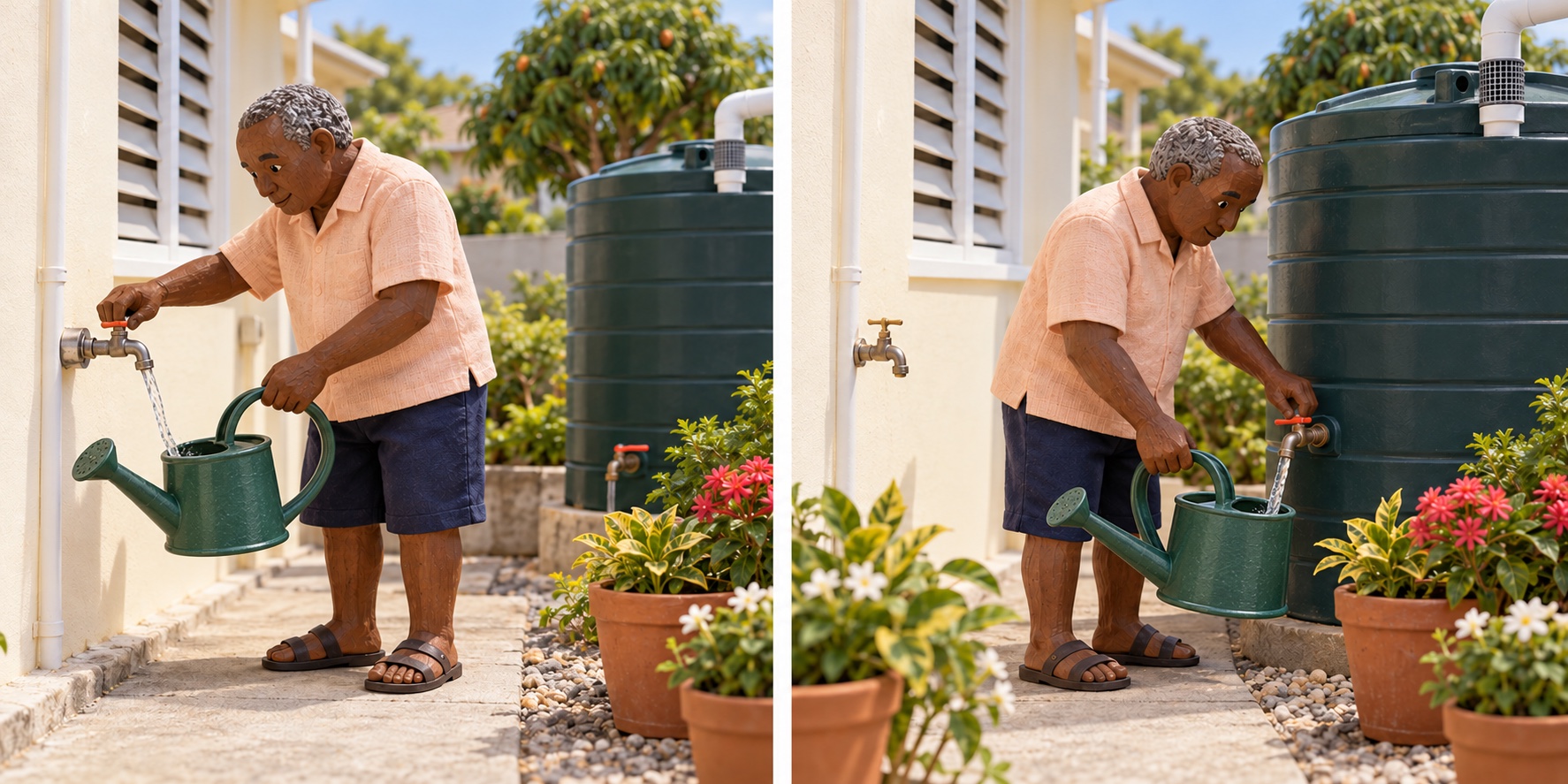
Use safely stored rainwater for a suitable task
Why this can help
An existing rainwater system can supply a necessary non-drinking use instead of mains water. Caribbean technical guidance explains safe management; household research elsewhere supports a reduction in mains demand, with results that vary by site.
One possible next step
If a maintained system is already available, identify a permitted non-drinking use and measure only the mains water it replaces.
What changes the outcome
Use only a suitable maintained system, with protected storage, screens, first-flush management and separation from drinking-water pipes. Follow local advice. Do not drink untreated rainwater or improvise connections. Watering must already be needed. Pumps, cleaning and treatment can use energy; no carbon saving is assumed.
Your illustrative scenario
Over one year · with the assumptions below
You
320 litres of water used less
You + 10 friends
3,520 litres of water used less
1,000 participants
320,000 litres of water used less
These are scenarios, not measured personal or collective savings. One separate household per participant. People sharing a home count it once, not once each.
Your inputs
- Mains water otherwise needed per suitable task
- 10 L
- Suitable stored rainwater actually used
- 8 L
- Additional mains water for this use
- 0 L
- Suitable tasks with water available per year
- 40
Calculation of the difference: [min(8, 10) − 0] L × 40 = 320 litres of water used
Calculation boundaries
The same necessary non-drinking task with an already maintained rainwater system. Count only water that replaces mains supply, including additional mains water for cleaning or operation. Exclude rainwater already committed to another necessary use, extra watering created by availability and tank capacity that is never used. This is a water balance, not a lifecycle energy or carbon result.
The displayed quantities and frequency are hypothetical examples. Neither the Australian household study nor the Caribbean handbook supplies these values. Replace them with appropriate local use and actual availability.
Sources and calculation references
- Handbook for Rainwater Harvesting for the CaribbeanUnited Nations Environment Programme / Caribbean Environmental Health Institute · 2009
- A Desktop Analysis of Potable Water Savings from Internally Plumbed Rainwater Tanks in South-East Queensland, AustraliaCara D. Beal, A. Sharma, T. Gardner and M. Chong · 2012
- Environmental benefit analysis of strategies for potable water savings in residential buildingsAna Kelly Marinoski, Ricardo Forgiarini Rupp and Enedir Ghisi · 2018
Read the method: universalizable.com/en/method/ · One sheet · print double-sided, long-edge binding