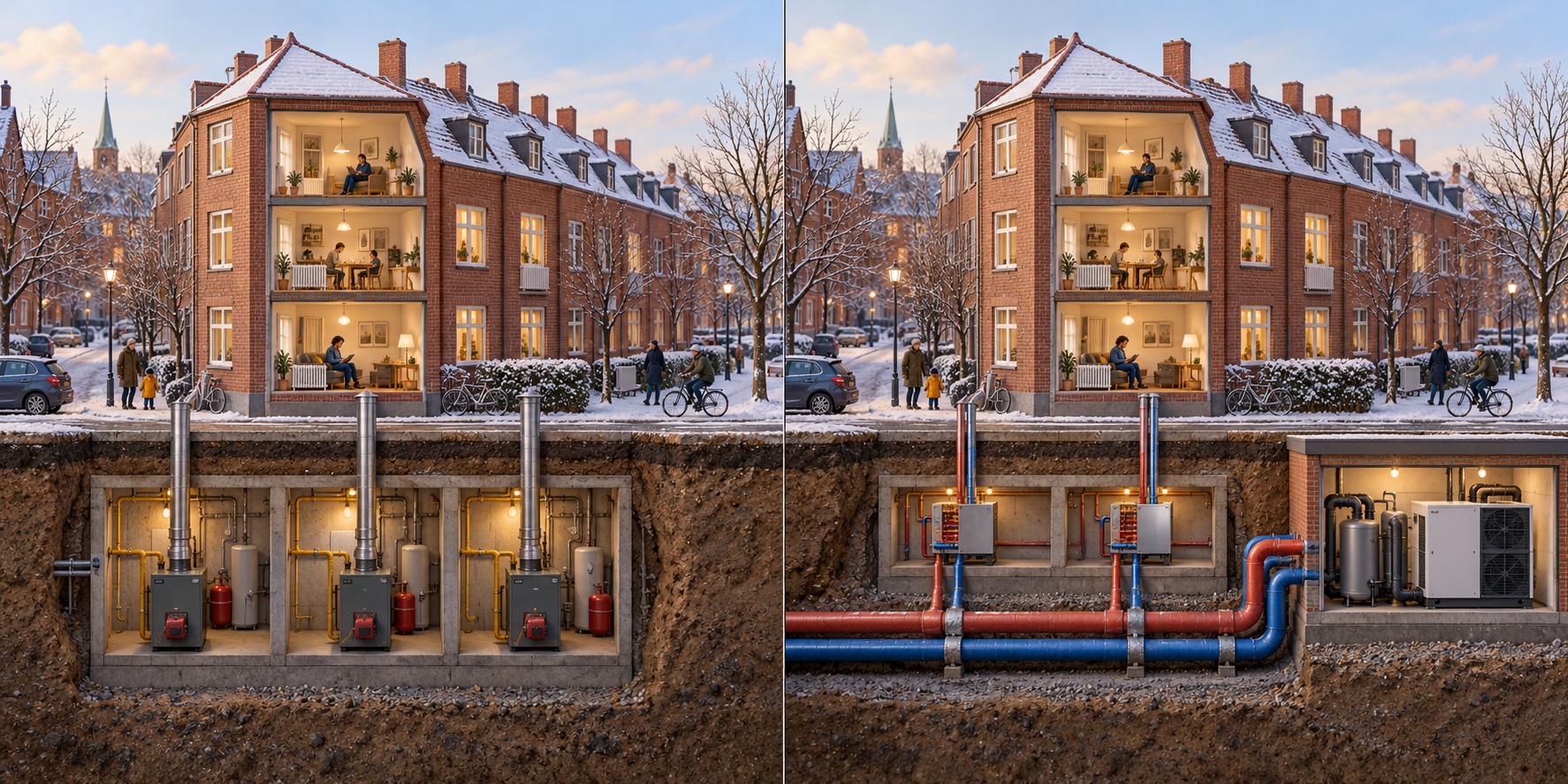
Illustrated comparison inspired by the place and case. Conceptual scenes, not a photographic before and after.
How the change works
- 01 / Public decision
Heat network and suitable sources
- 02 / Physical change
Heat recovered or efficiently produced
- 03 / Possible outcome
Less fuel, if the mix improves
A network makes it possible to use recovered heat, large heat pumps or other sources suitable for the territory for multiple buildings.
Research and local documents ↓What the evidence tells us
The Danish Energy Agency documents systems that combine different technologies; in 2024, about 69% of Danish families were connected to district heating.
Families connected to district heating
69 %Connect to the heat network
31 %Other systems
Rounded value; the complement is calculated. The extension of the network does not measure its climate footprint.
Open the source ↗Read values and method
| Indicator | Value |
|---|---|
| Connect to the heat network | 69 % |
| Other systems | 31 % |
Rounded value; the complement is calculated. The extension of the network does not measure its climate footprint.
Conditions and limits
The network alone is not clean: sources, losses and temperatures count. Biomass and incineration have impacts; they are not synonymous with zero emissions.
Other possible benefits
Possible use of heat that would otherwise be lost.
Research and local documents
- Local document and reported findingDanish Energy Agency · district heating in Denmark ↗
The Danish Energy Agency documents systems that combine different technologies; in 2024, about 69% of Danish families were connected to district heating.
- Scientific basis of the mechanismIPCC AR6 WGIII · Chapter 6: Energy Systems, 2022 ↗
Scientific synthesis on sources, networks and decarbonization of the energy system. It does not attribute personal CO₂ savings to the individual project.

