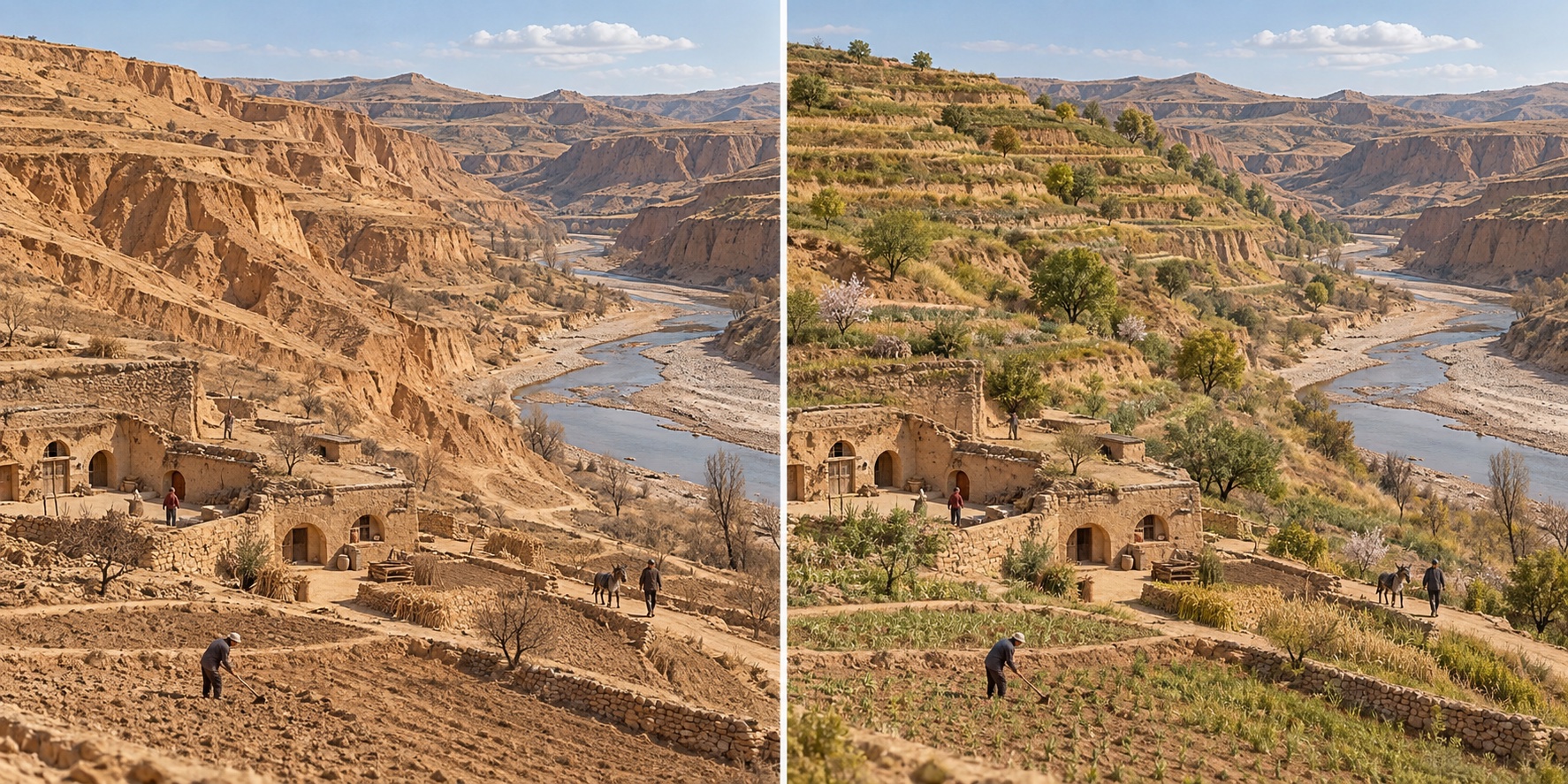
How the change works
- 01 / Public decision
Soil-water project
- 02 / Physical change
Vegetation and slope management
- 03 / Possible outcome
Erosion and water evaluated together
Restoring the slopes may contain erosion, but the vegetation uses water: the project must respect the water balance of the basin.
Research and local documents ↓What the evidence tells us
The recovery of the Loess Plateau combines soil management and revegetation. The research by Feng and colleagues highlights that the expansion of vegetation may approach the limits of available water resources.
Putting the choices into practice
Soil
The challengeExposed slopes
The responseGround cover against erosion
Water
The challengeConsumption not assessed
The responseCatchment water balance
Species
The challengePlant everywhere the same way
The responseVegetation suitable for the location
The diagram compares choices and conditions for putting them into practice. Measured outcomes and their limits are discussed in the evidence.
Research and local documents ↓Conditions and limits
Reducing erosion does not mean always increasing water in rivers. Density and species must be adapted to local conditions, taking into account consumption and climate.
Other possible benefits
More stable soils and agricultural activities less exposed to land loss.
Research and local documents
- Local document and reported findingFeng et al., 2016 · Revegetation and sustainable water resource limits ↗
Research on the case, mechanism, or measures discussed in the sheet.
- Local project or policy documentWorld Bank · Recovery of basins in the Loess Plateau ↗
Description of the land recovery project; to be read together with studies on water balance.

