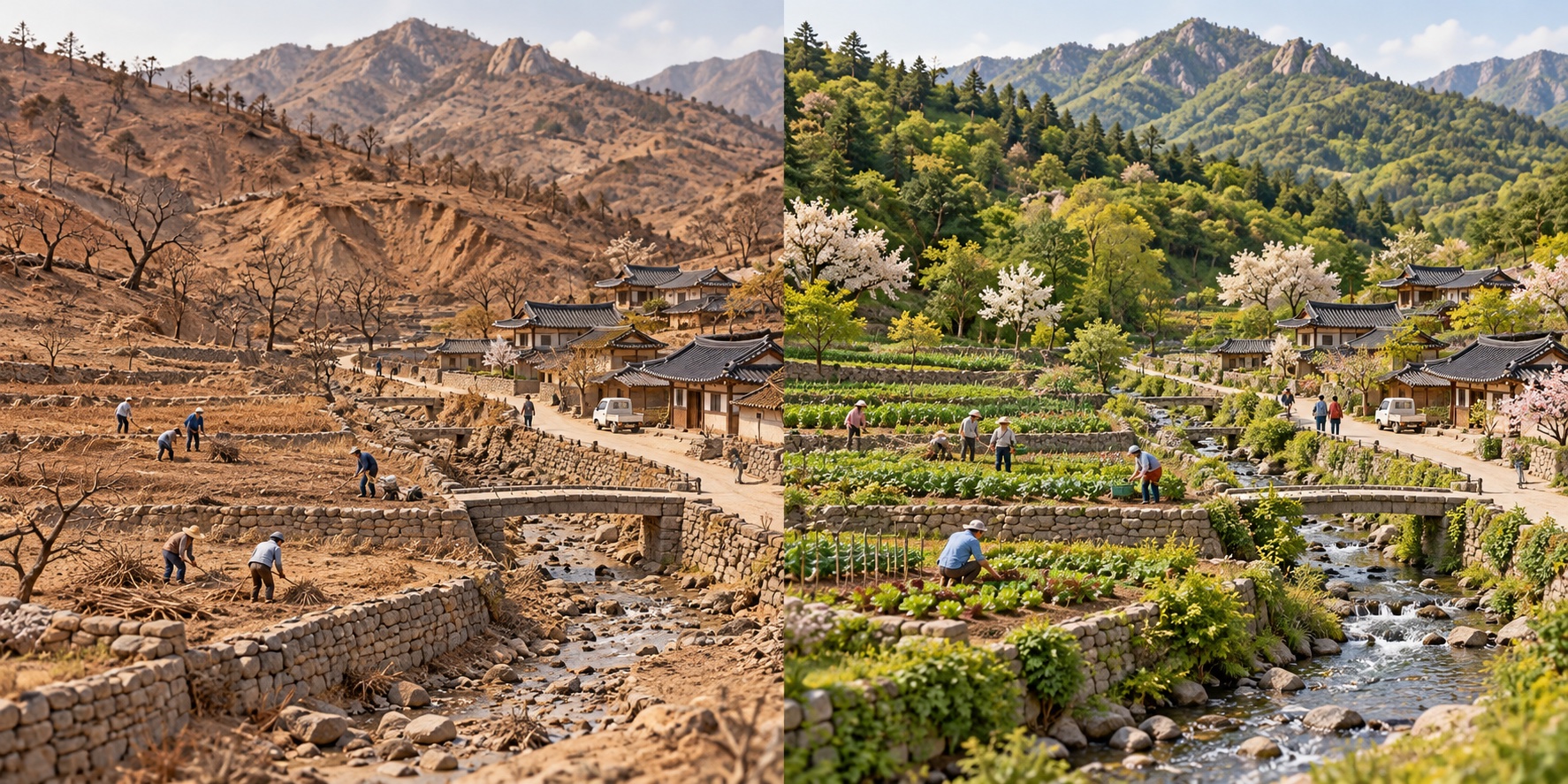
How the change works
- 01 / Public decision
Long-term program
- 02 / Physical change
Planting, protection and care
- 03 / Possible outcome
Reconstructed forest heritage
Rebuilding a forest requires planting, protection and management for decades, together with conditions that make it possible to conserve it.
Research and local documents ↓What the evidence tells us
The FAO and Korea Forest Service report describes South Korean forest rehabilitation. The volume of timber per hectare increased from 9.6 m³ in 1960 to 125.6 m³ in 2010 in the report series.
The forest also grows in volume
9.6 m³ per hectare1960
125.6 m³ per hectare2010
Timber volume per hectare in the FAO/Korea Forest Service table. Not forest area nor index of biodiversity.
Open the source ↗Read values and method
| Indicator | Value |
|---|---|
| 1960 | 9.6 m³ per hectare |
| 2010 | 125.6 m³ per hectare |
Timber volume per hectare in the FAO/Korea Forest Service table. Not forest area nor index of biodiversity.
Putting the choices into practice
Time
The challengeOne-time intervention
The responseDecades of care
Indicator
The challengeCount only the seedlings
The responseMeasuring growth and survival
Quality
The challengeTimber volume alone
The responseAlso habitats and species
The diagram compares choices and conditions for putting them into practice. Measured outcomes and their limits are discussed in the evidence.
Research and local documents ↓Conditions and limits
The volume per hectare is not the forest area and does not alone measure biodiversity or habitat quality. The transformation includes economic and energy changes in addition to forest programs.
Other possible benefits
Slope protection and availability of forest spaces over time.
Research and local documents
- Local project or policy documentKorea Forest Service/FAO · Forest rehabilitation in the Republic of Korea ↗
Institutional documentation of the program, territory or rules mentioned.

