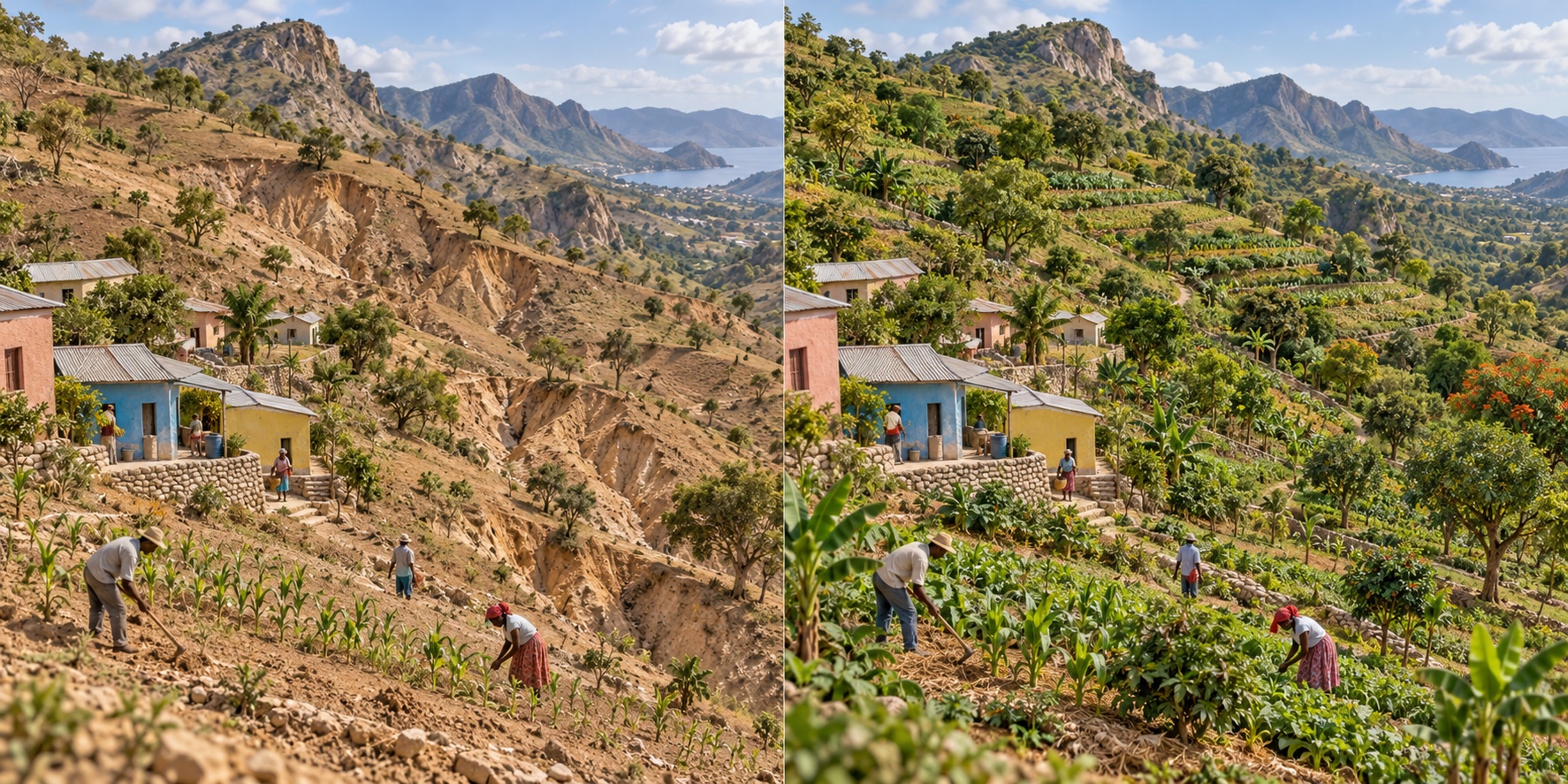
How the change works
- 01 / Public decision
Verifiable definitions and map
- 02 / Physical change
Restoration agreed with the inhabitants
- 03 / Possible outcome
Monitored soil and vegetation
To restore a landscape, it is necessary to distinguish between forest, plantations and trees in the fields, then choose interventions suitable for people and soils.
Research and local documents ↓What the evidence tells us
The study by Pauleus and Aide shows that forest cover in Haiti is greater than some oft-cited estimates suggest. The meaning of forest changes with definitions, thresholds, and method of detection.
Putting the choices into practice
Definition
The challengeA single ambiguous percentage
The responseDistinguishing forests from tree cover
Intervention
The challengeSame recipes everywhere
The responseRestoration suited to the hillside
Verification
The challengeTwo images without a method
The responseComparable series and criteria
The diagram compares choices and conditions for putting them into practice. Measured outcomes and their limits are discussed in the evidence.
Research and local documents ↓Conditions and limits
Primary forest and tree cover are not synonymous. The comparison is not a ranking between Haiti and the Dominican Republic and the restoration scene is a possibility, not a national result already obtained.
Other possible benefits
A more reliable basis for deciding where to restore and how to support livelihoods.
Research and local documents
- Local document and reported findingPauleus and Aide, 2020 · Haiti has more forest than previously reported ↗
Research on the case, mechanism, or measures discussed in the sheet.
- Local project or policy documentUNEP—GEF · Ecosystem restoration in Haiti ↗
Restoration project in priority landscapes with community-led models; objectives, not national results already obtained.

