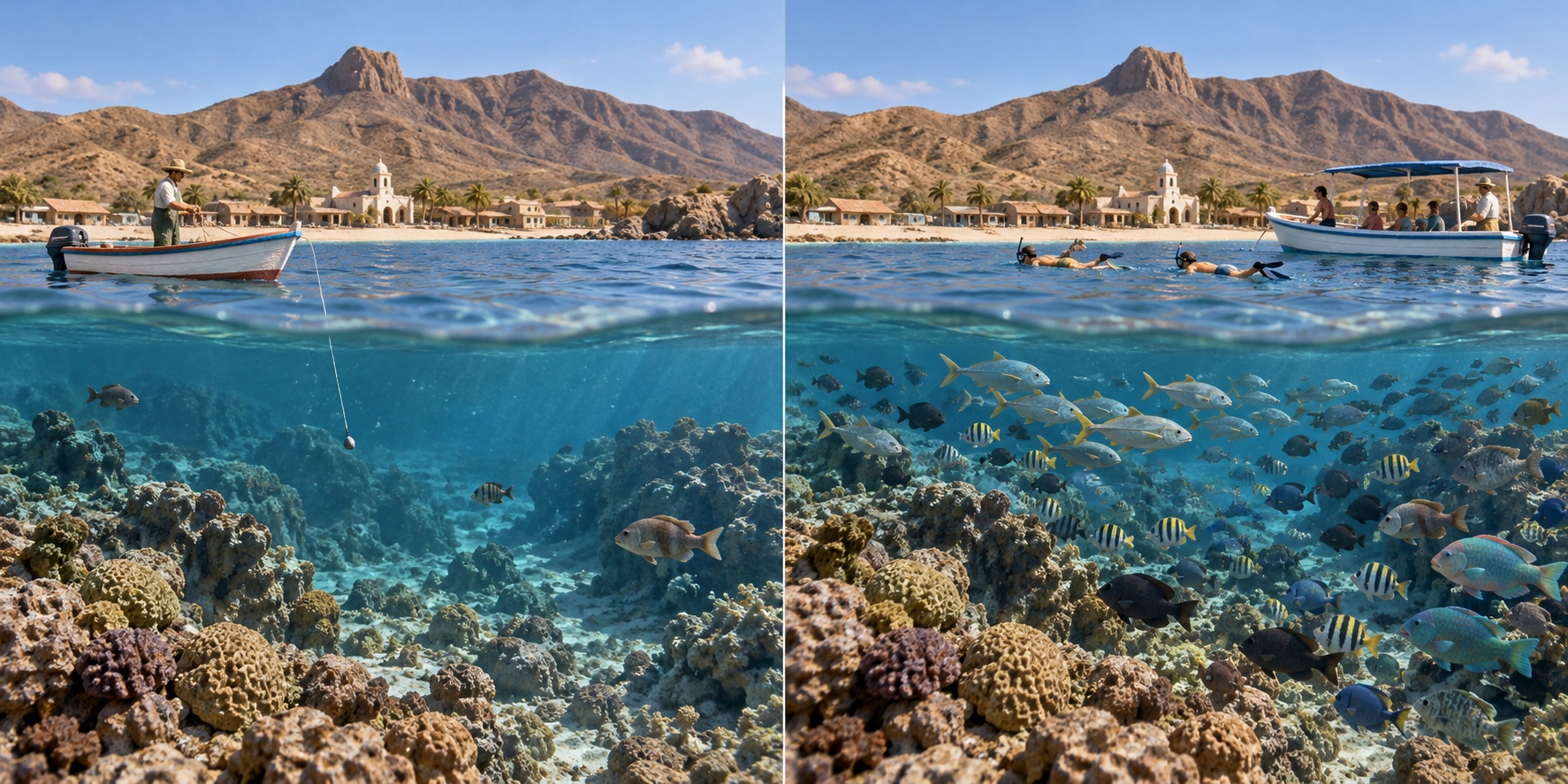
How the change works
- 01 / Public decision
Area without fishing
- 02 / Physical change
Surveillance and compliance with the rules
- 03 / Possible outcome
Fish biomass is recovering
Protecting an area from fishing can allow fish to grow and reproduce, when rules and oversight work.
Research and local documents ↓What the evidence tells us
In Cabo Pulmo, the fish biomass detected by the study increased from 0.75 to 4.24 tons per hectare between 1999 and 2009. The work also compares other areas of the region.
More fish biomass in the reserve
0.75 t per hectare1999
4.24 t per hectare2009
Fish biomass detected in the study, over ten years. The comparison does not measure the recovery of the coral.
Open the source ↗Read values and method
| Indicator | Value |
|---|---|
| 1999 | 0.75 t per hectare |
| 2009 | 4.24 t per hectare |
Fish biomass detected in the study, over ten years. The comparison does not measure the recovery of the coral.
Putting the choices into practice
Protection
The challengeFishing in the area
The responseZone closed to fishing
Implementation
The challengeA boundary only on paper
The responseEffective surveillance
Indicator
The challengeNumber of visitors
The responseFish biomass
The diagram compares choices and conditions for putting them into practice. Measured outcomes and their limits are discussed in the evidence.
Research and local documents ↓Conditions and limits
It's an observed recovery, not a randomized experiment. The data concerns fish biomass: it does not prove that every coral reef regenerates in the same way.
Other possible benefits
Ecological value of the sea and local opportunities compatible with protection.
Research and local documents
- Local document and reported findingAburto-Oropeza et al., 2011 · Large Recovery of Fish Biomass in a No-Take Marine Reserve ↗
Research on the case, mechanism, or measures discussed in the sheet.
- Local project or policy documentCONANP · Cabo Pulmo National Park ↗
Protected area sheet, location and decree of June 6, 1995.
