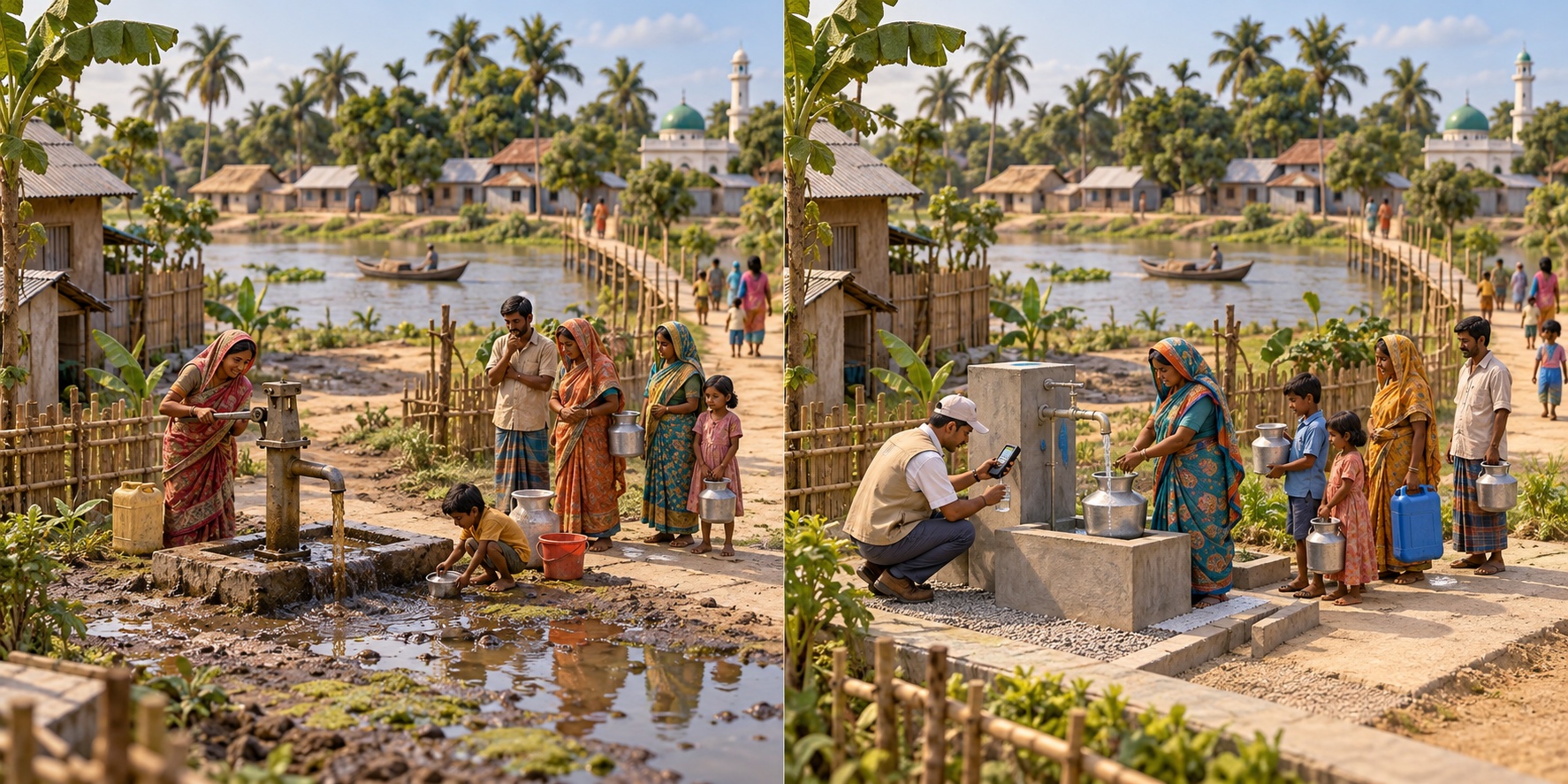
How the change works
- 01 / Public decision
Test and communication
- 02 / Physical change
Accessible and verified alternatives
- 03 / Possible outcome
Lower exposure to arsenic
Arsenic can be present without changing the appearance or taste of the water. Measuring it is only useful if people can access a verified alternative.
Research and local documents ↓What the evidence tells us
Studies in Araihazar, Bangladesh, analyze risk communication, well change and exposure over time. Information and access to appropriate sources are complementary parts of the intervention.
Putting the choices into practice
Risk
The challengeWater evaluated by color
The responseMeasured arsenic
Information
The challengeIncomprehensible outcome
The responseClear, usable guidance
Alternative
The challengeDistant or untested source
The responseAccess to a verified well
The diagram compares choices and conditions for putting them into practice. Measured outcomes and their limits are discussed in the evidence.
Research and local documents ↓Conditions and limits
Changing the well does not guarantee that every exposure will be eliminated. Reliable analysis, accessibility, and repeated checks of alternative sources are needed.
Other possible benefits
Reduction of inequalities in access to a reliable source.
Research and local documents
- Local document and reported findingRandomized study on arsenic risk communication in Bangladesh ↗
Research on the case, mechanism, or measures discussed in the sheet.
- Local document and reported findingFollow-up of arsenic exposure in Araihazar, 2001—2015 ↗
Research on the case, mechanism, or measures discussed in the sheet.

