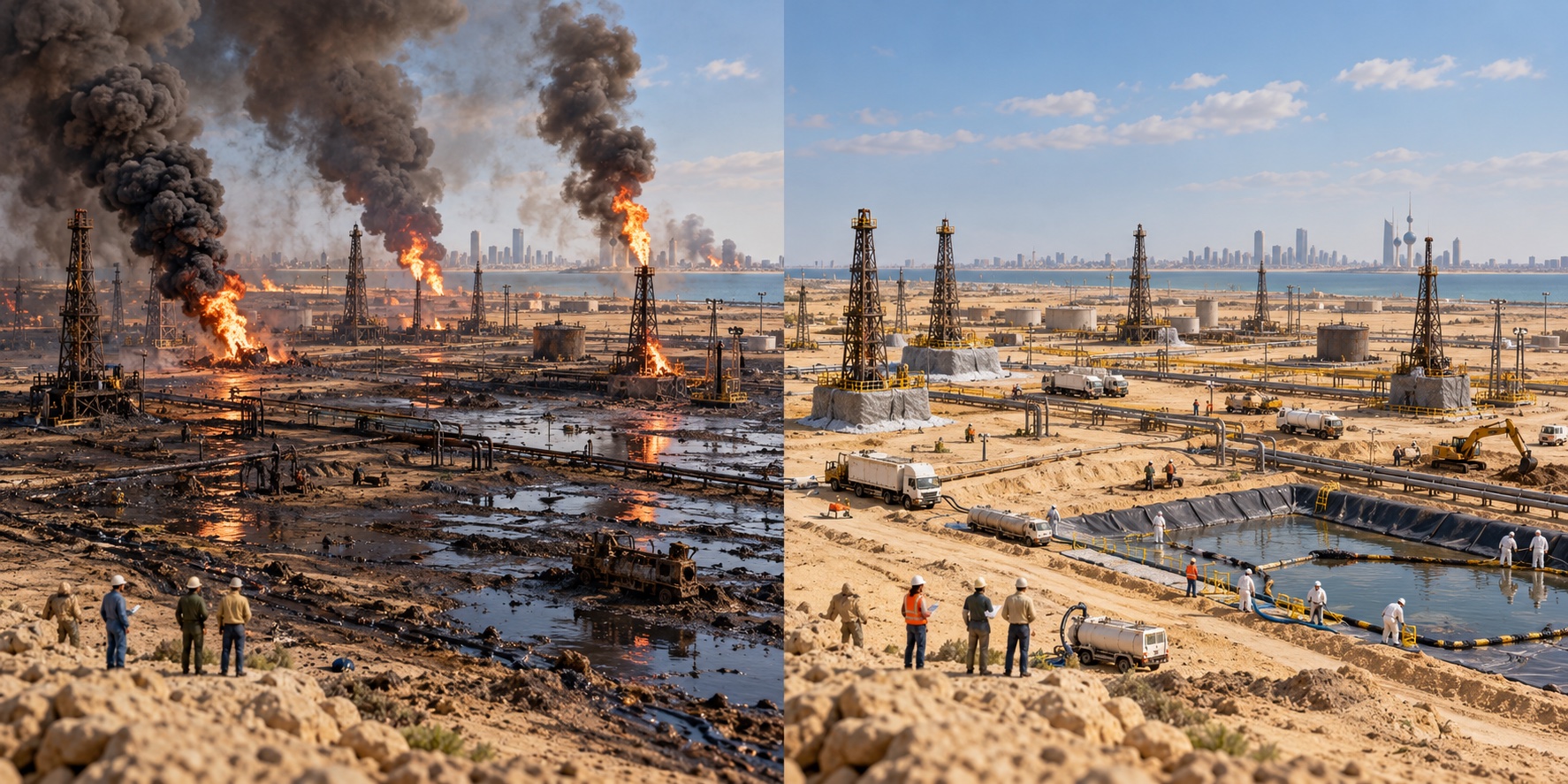
How the change works
- 01 / Public decision
Prevention and protection
- 02 / Physical change
Avoidated or contained fires and releases
- 03 / Possible outcome
Reduced environmental damage
Destroying a plant can transform it into a source of emissions and contamination. Protecting infrastructure also avoids this part of the damage.
Research and local documents ↓What the evidence tells us
The 1991 air campaigns in Kuwait measured the composition and emissions of the fumes from oil fires. The case shows directly observed atmospheric effects.
Putting the choices into practice
Time
The challengeFlow rate exchanged for total
The responseDeclared measurement window
Response
The challengeExtinguishing the fires alone
The responseEven air and soil
Prevention
The challengeIndustrial facilities as targets
The responseProtected infrastructure
The diagram compares choices and conditions for putting them into practice. Measured outcomes and their limits are discussed in the evidence.
Research and local documents ↓Conditions and limits
The flow rates measured during the campaign are not annual totals. The 2% comparison found in the research is not a permanent share of world emissions.
Other possible benefits
Protection of workers, residents and resources contaminated by accidents.
Research and local documents
- Local document and reported findingHobbs and Radke, 1992 · Airborne studies of the smoke from the Kuwait oil fires ↗
Research on the case, mechanism, or measures discussed in the sheet.
- Local document and reported findingFerek et al., 1992 · Chemical composition of emissions from the Kuwait oil fires ↗
Research on the case, mechanism, or measures discussed in the sheet.