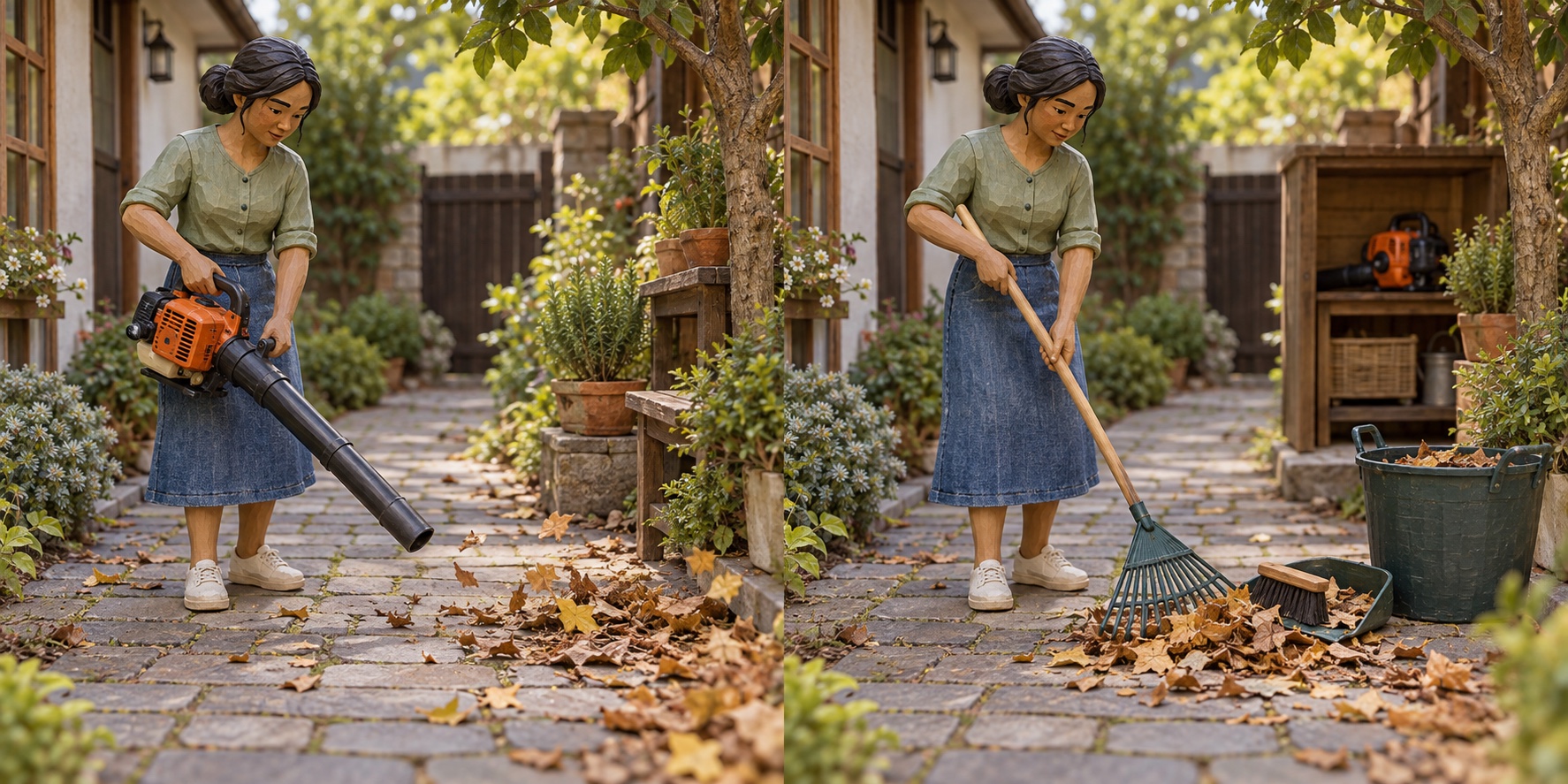
Rake a small area instead of using a petrol blower
Why this can help
A manual tool avoids the fuel combustion and exhaust from operating a petrol blower for that task. It can also reduce noise and disturbance.
One possible next step
For the next small path or patio clean-up, use a tool you already have if comfortable and practical.
What changes the outcome
Match the tool to physical abilities and area. Small-engine smog pollutants and carbon dioxide are different measures; no car-mile equivalence is used here.
Your illustrative scenario
Over one year · with the assumptions below
You
2 litres of fuel used less
You + 10 friends
22 litres of fuel used less
1,000 participants
2,000 litres of fuel used less
These are scenarios, not measured personal or collective savings. One separate household per participant. People sharing a home count it once, not once each.
Your inputs
- Petrol per complete clearing task Before
- 0.1 L fuel
- Petrol per complete clearing task After
- 0 L fuel
- Comparable occasions per year
- 20
Calculation of the difference: (0.1 − 0) × 20 = 2 litres of fuel used
Calculation boundaries
Count only the specified material. This is not a life-cycle assessment and does not convert material into carbon, water quality or biodiversity benefits. Include any remaining motorised finishing of the same area. Match the tool to physical abilities and area. Small-engine smog pollutants and carbon dioxide are different measures; no car-mile equivalence is used here.
The initial values are editable arithmetic examples, not measurements or typical savings from the cited studies. Replace them with comparable readings for your situation. The sources support the mechanism and its conditions; they do not predict these numbers.
Sources and calculation references
- CARB — Small off-road engines, report (2016)CARB · 2016
Read the method: universalizable.com/en/method/ · One sheet · print double-sided, long-edge binding