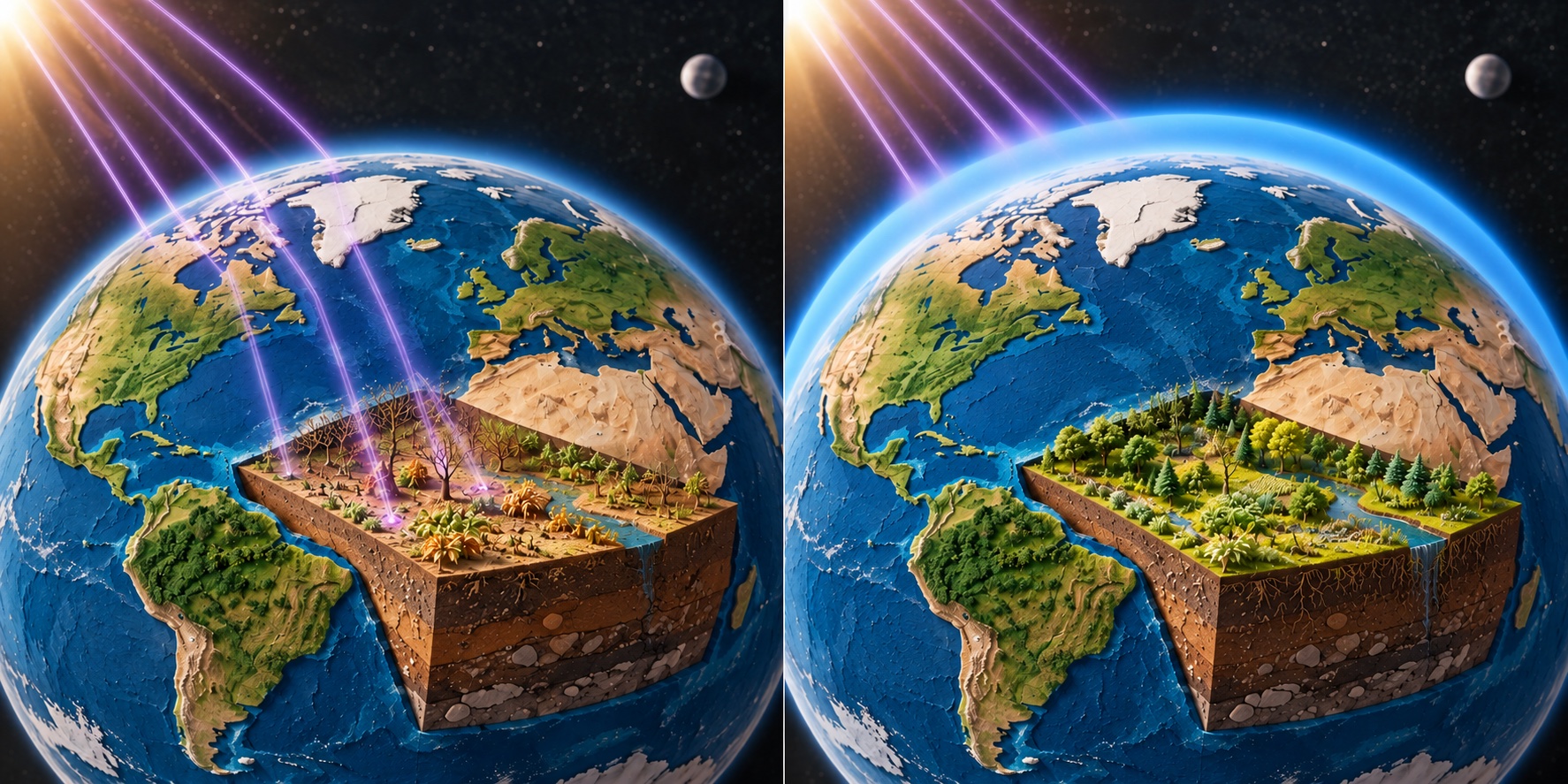
Illustrated comparison inspired by the place and case. Conceptual scenes, not a photographic before and after.
How the change works
- 01 / Public decision
Agreements and controls on substances
- 02 / Physical change
Less ozonolesic substances in the atmosphere
- 03 / Possible outcome
Ultraviolet protection
International rules applied to the production and use of ozonolesic substances protect the layer that absorbs part of the ultraviolet radiation.
Research and local documents ↓What the evidence tells us
Newman and colleagues have simulated a world without regulation: with production growing 3% per year, global ozone in 2065 would be 67% lower than in 1980.
Conditions and limits
It's a modeled counterfactual, not a prediction of the current world. In the illustration, the atmospheric layer is schematic and not scaled.
Other possible benefits
Protection of health and organisms exposed to UV.
Research and local documents
- Evidence for this findingNewman et al. · Atmospheric Chemistry and Physics, 2009 ↗
Newman and colleagues have simulated a world without regulation: with production growing 3% per year, global ozone in 2065 would be 67% lower than in 1980.
- Local project or policy documentUNEP Ozone Secretariat · Montreal Protocol ↗
Text and institutional framework of the Global Agreement on Ozone-Depleting Substances. The estimation of the world without a protocol comes from scientific study.