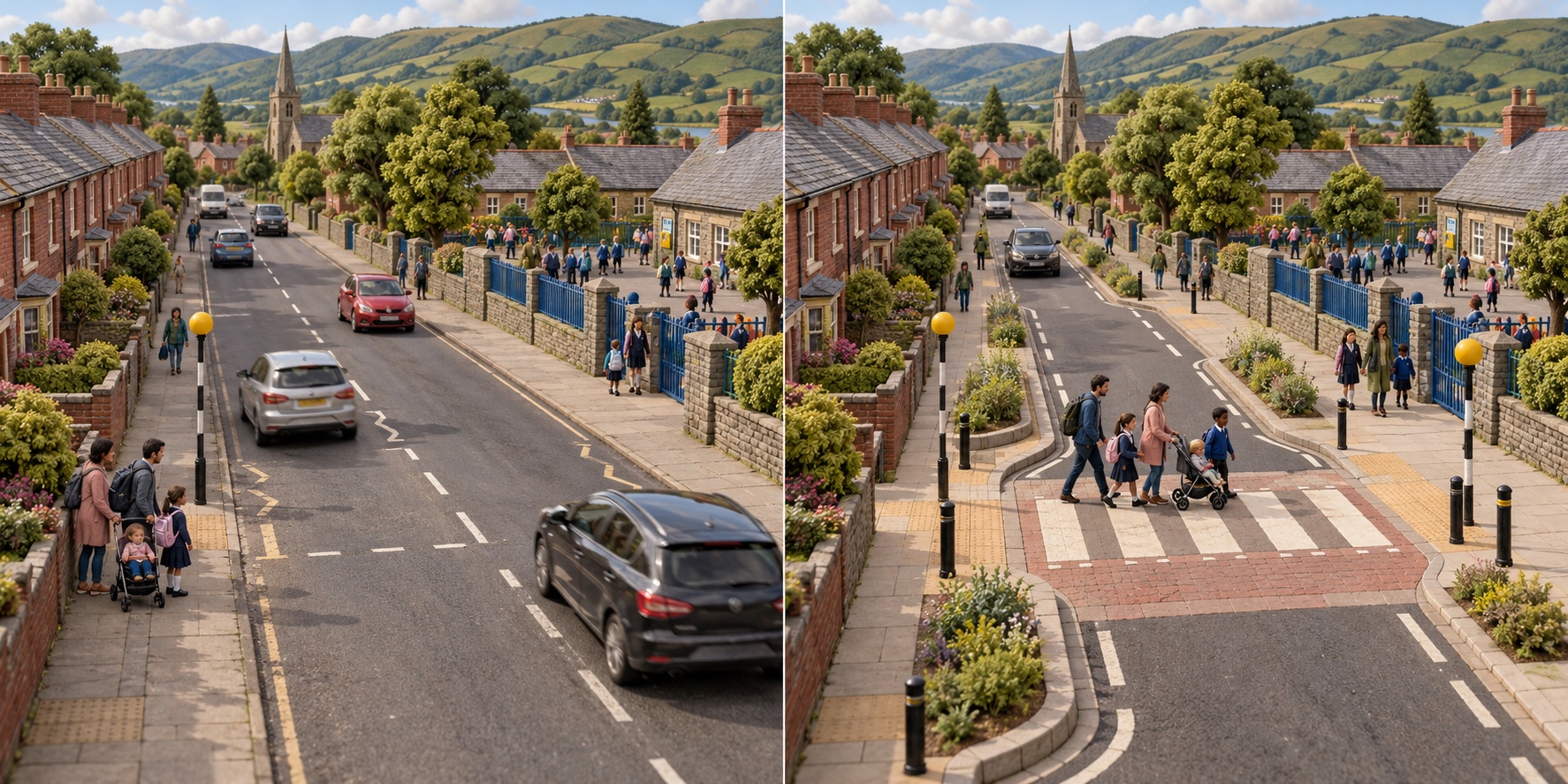
Illustrated comparison inspired by the place and case. Conceptual scenes, not a photographic before and after.
How the change works
- 01 / Public decision
Consistent speed and road
- 02 / Physical change
Lower energy in shocks
- 03 / Possible outcome
Safer crossings
Lower speeds reduce impact energy and stopping distance; together with the road design, they make it more practical to walk.
Research and local documents ↓What the evidence tells us
Welsh data for the first year after the introduction of the default 20 mph limit shows fewer victims on 20 and 30 mph roads considered together.
Conditions and limits
It's an initial time comparison, not an isolated proof of causation. The documented benefit is above all safety; we do not attribute fixed CO₂ savings.
Other possible benefits
More favorable conditions for walking and cycling.
Research and local documents
- Local document and reported findingWelsh Government · road statistics, January 2025 ↗
Welsh data for the first year after the introduction of the default 20 mph limit shows fewer victims on 20 and 30 mph roads considered together.
- Scientific basis of the mechanismElvik et al. · Accident Analysis & Prevention, 2019 ↗
Review of the relationship between speed and safety. It supports the mechanism, it does not prove that the local data depends on a single measure.

