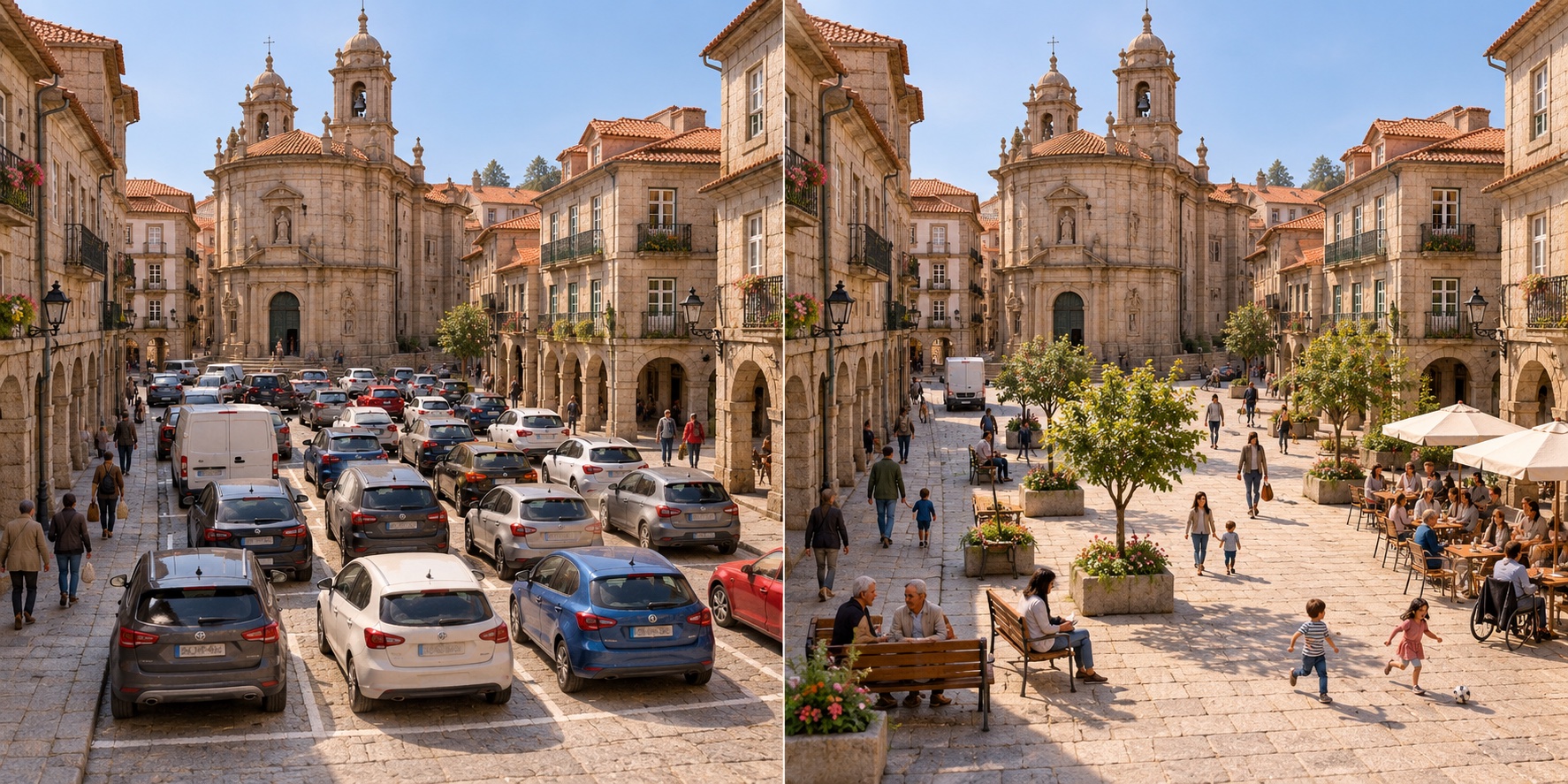
Illustrated comparison inspired by the place and case. Conceptual scenes, not a photographic before and after.
How the change works
- 01 / Public decision
Accessibility and moderate traffic
- 02 / Physical change
Less space taken up by cars
- 03 / Possible outcome
More viable active mobility
A hierarchy that gives priority to those who walk changes the use of public space and reduces the need to cross the center by car.
Research and local documents ↓What the evidence tells us
The City documents a transformation started in 1999, with pedestrianization, sidewalks, traffic moderation and accessibility.
Conditions and limits
Local assessments don't isolate every single measure. We do not recover CO₂ percentages without a verifiable method.
Other possible benefits
Space to meet and access for different needs.
Research and local documents
- Local document and reported findingConcello de Pontevedra · city model ↗
The City documents a transformation started in 1999, with pedestrianization, sidewalks, traffic moderation and accessibility.
- Scientific basis of the mechanismIPCC AR6 WGIII · Chapter 8: Urban systems, 2022 ↗
Scientific basis on the relationships between urban form, infrastructure and energy demand; it does not measure the effect of local reform on its own.
