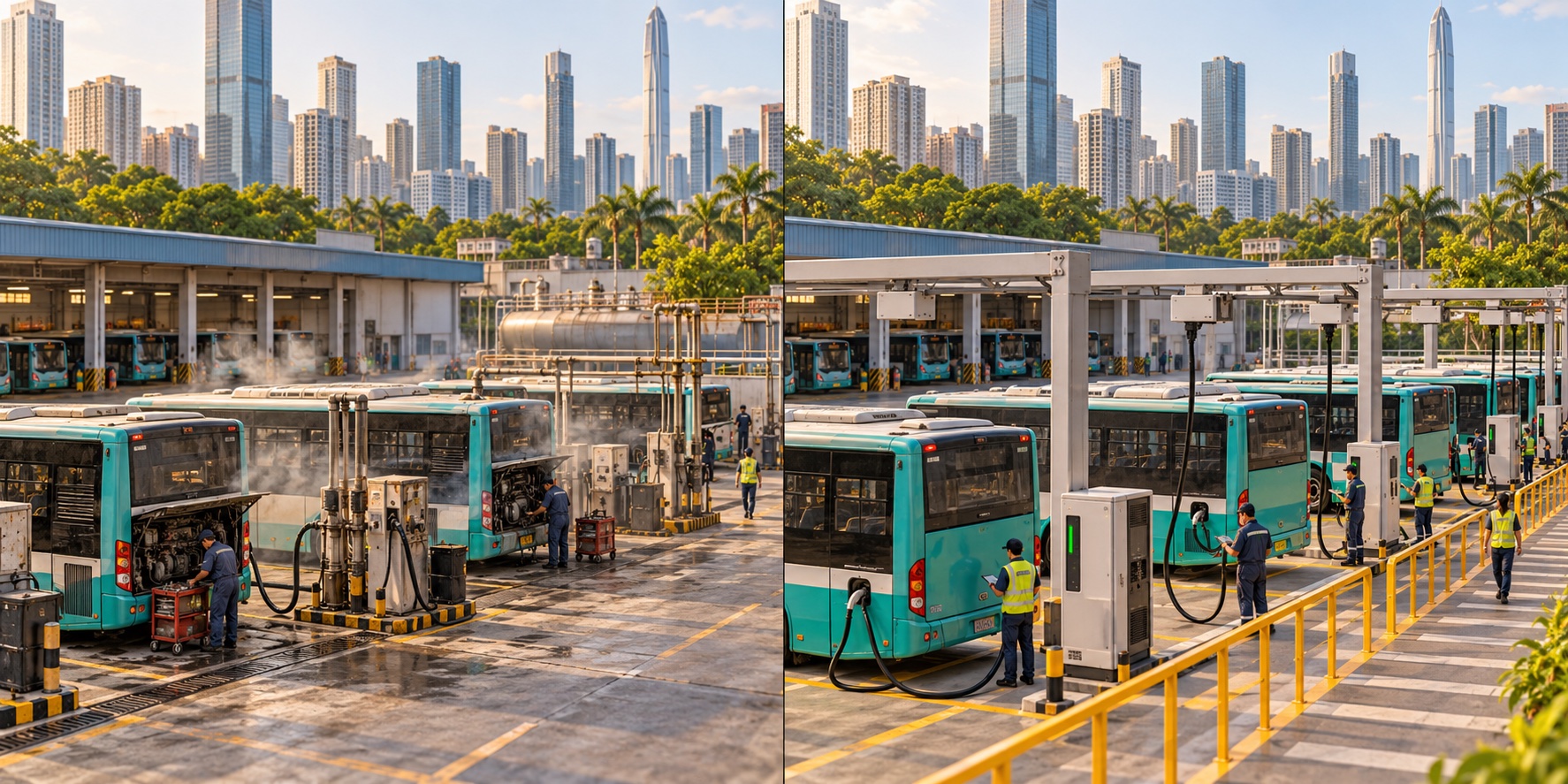
Illustrated comparison inspired by the place and case. Conceptual scenes, not a photographic before and after.
How the change works
- 01 / Public decision
Electric fleet and coordinated charging
- 02 / Physical change
Electricity instead of diesel
- 03 / Possible outcome
Less CO₂ operating in the studied scenario
Electrification eliminates local engine exhaust and can reduce CO₂, depending on the energy used for charging.
Research and local documents ↓What the evidence tells us
Mao and colleagues compare electric and diesel buses in Shenzhen including energy production, finding lower operational CO₂ emissions for electric vehicles in the studied scenario.
Conditions and limits
The comparison is not equivalent to a full vehicle life cycle. The result depends on network, distance and management. The case does not describe a free local electoral choice.
Other possible benefits
Less exhaust emissions along the lines.
Research and local documents
- Evidence for this findingMao, Li and Zhang · Sustainability, 2021 ↗
Mao and colleagues compare electric and diesel buses in Shenzhen including energy production, finding lower operational CO₂ emissions for electric vehicles in the studied scenario.
- Local project or policy documentShenzhen Transport Bureau · Green Public Transport ↗
The local authority documents the electrification; the comparison of emissions comes from a scientific study.
- Scientific basis of the mechanismIPCC AR6 WGIII · Chapter 10: Transport, 2022 ↗
Scientific synthesis of the mechanism: active mobility, collective transport, efficiency and energy mix. It is not a causal assessment of the individual local project.
