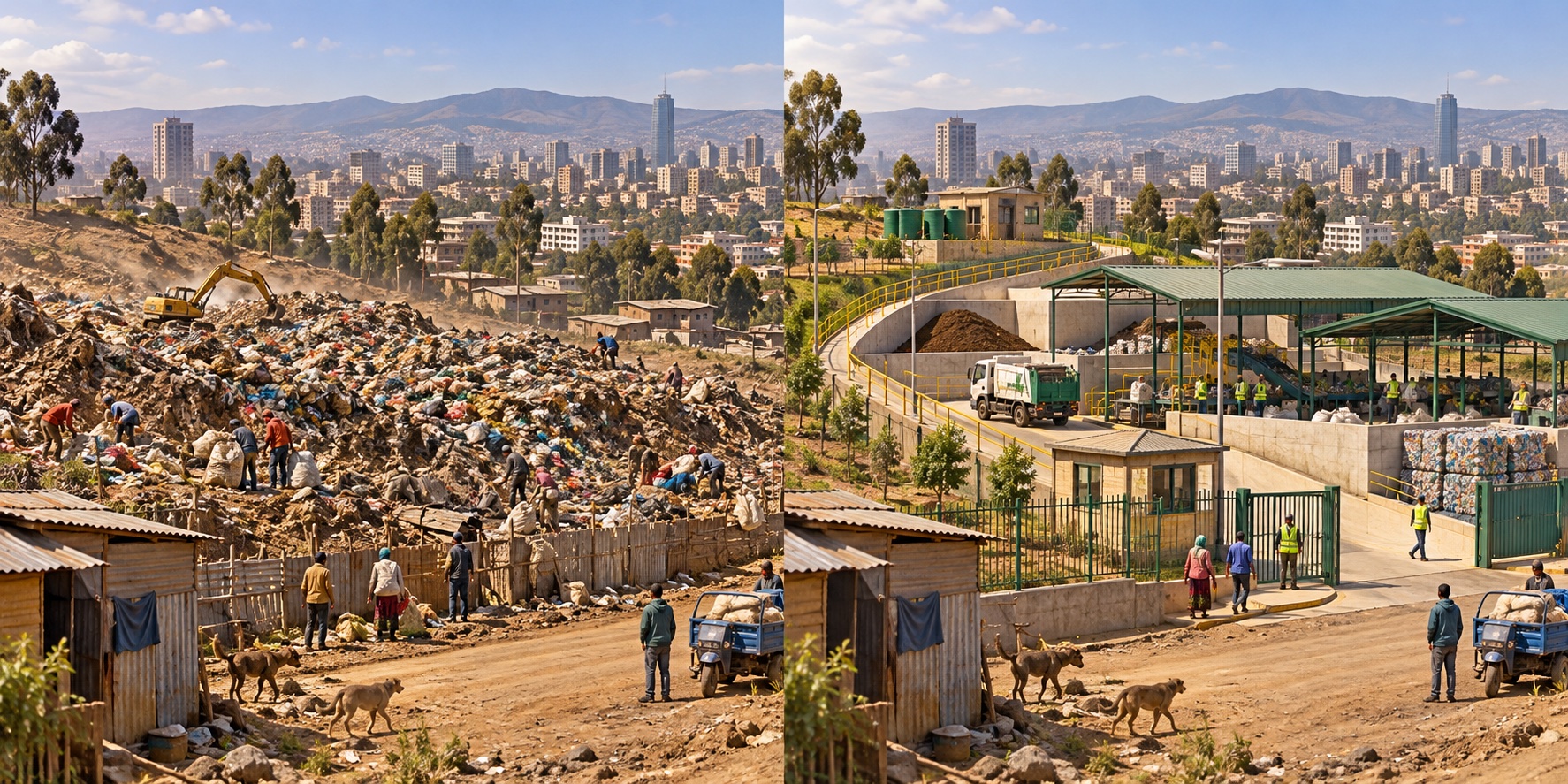
How the change works
- 01 / Public decision
Labor planning and protection
- 02 / Physical change
Controlled sites
- 03 / Possible outcome
Lower exposure to risks
Waste management must prevent instability, fires and exposures, including people who live or work near facilities.
Research and local documents ↓What the evidence tells us
The 2017 Koshe landslide shows the consequences of an insecure system. Geotechnical research clarifies why height, slope, water and materials require specific assessments.
Putting the choices into practice
Slopes
The challengeAccumulate without control
The responseVerified stability
Water
The challengeNeglected infiltrations
The responseDrainage and monitoring
People
The challengeWork without protection
The responseInclusion and security
The diagram compares choices and conditions for putting them into practice. Measured outcomes and their limits are discussed in the evidence.
Research and local documents ↓Conditions and limits
A general stability study does not reconstruct Koshe's causes on its own. A new plant is not enough if it leaves people without income or protection.
Other possible benefits
Resident safety and recognition of work in the collection.
Research and local documents
- Evidence for this findingProbabilistic analysis of the stability of urban solid waste slopes ↗
Research on the case, mechanism, or measures discussed in the sheet.
- Local project or policy documentUNEP · The Koshe case and the transformation of the Addis Ababa system, 2017 ↗
Context of the site and the landslide. The description of the new plant is a program announced in 2017, not proof of its effectiveness.

