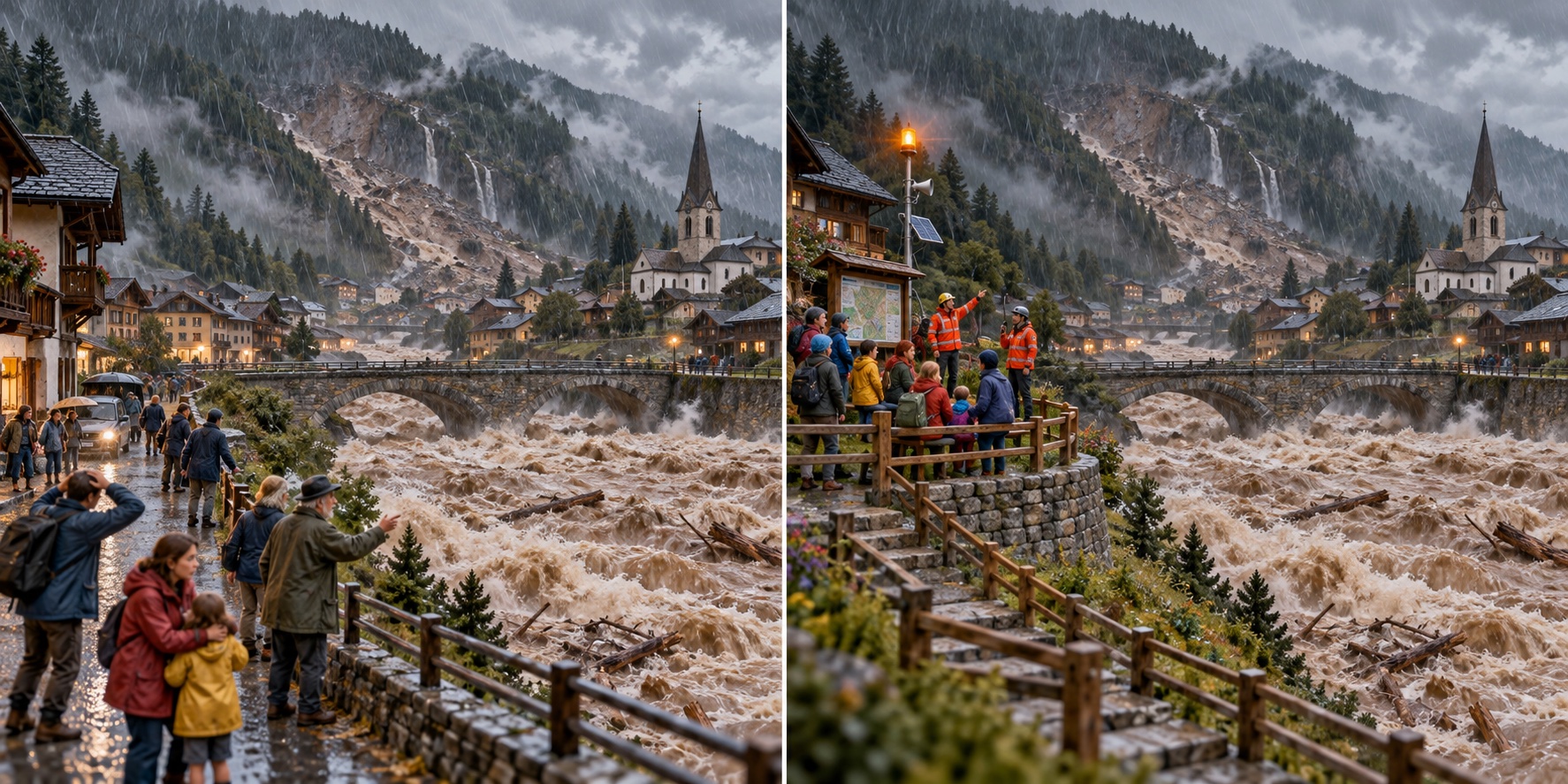
How the change works
- 01 / Public decision
Knowledge and monitoring
- 02 / Physical change
Accessible alert
- 03 / Possible outcome
Prepared response
A complete system combines risk knowledge, observation, communication and response capacity: a siren alone is not enough.
Research and local documents ↓What the evidence tells us
The WMO/UNDRR 2023 report finds less mortality in groups of countries with more comprehensive alert systems. The four components describe what it takes to transform a signal into protection.
Alert coverage and mortality
4.05 deaths per 100,000 peopleLimited system coverage
0.71 deaths per 100,000 peopleSubstantial or full coverage
Association between groups of countries. It's not a guaranteed causal reduction by installing a siren; it's not a statistic of the illustrated village.
Open the source ↗Read values and method
| Indicator | Value |
|---|---|
| Limited system coverage | 4.05 deaths per 100,000 people |
| Substantial or full coverage | 0.71 deaths per 100,000 people |
Association between groups of countries. It's not a guaranteed causal reduction by installing a siren; it's not a statistic of the illustrated village.
Putting the choices into practice
Risk
The challengeUnknown thresholds
The responseMaps and observation
Warning
The challengeOnly one channel
The responseRedundant channels
Response
The challengeSignal without a plan
The responseDrills and assistance
The diagram compares choices and conditions for putting them into practice. Measured outcomes and their limits are discussed in the evidence.
Research and local documents ↓Conditions and limits
The comparison between countries is an association, not the guaranteed causal effect of installing a system. Context, exposure, and resources differ.
Other possible benefits
Increased local capacity to deal with different risks.
Research and local documents
- Evidence for this findingUNDRR/WMO · Global Status of Multi-Hazard Early Warning Systems 2023 ↗
Institutional documentation of the program, territory or rules mentioned.
- Local project or policy documentFederal Office for the Environment · Hydrological forecasts and alerts in Switzerland ↗
Alpine example of observations, models, bulletins and alerts to authorities and the population. The card's numerical comparisons remain the global WMO/UNDRR comparisons.

