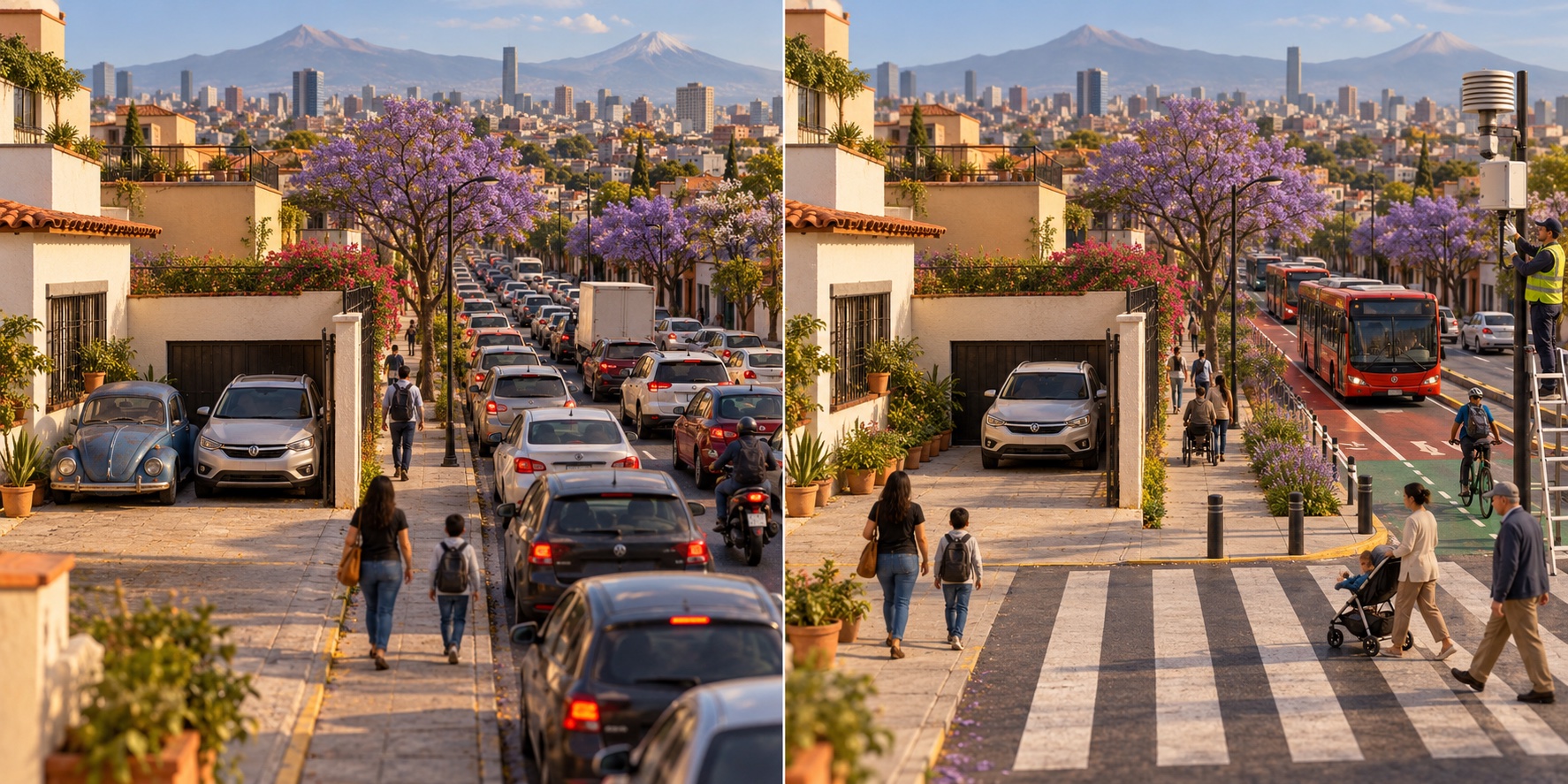
Illustrated comparison inspired by the place and case. Conceptual scenes, not a photographic before and after.
How the change works
- 01 / Public decision
Check the real effects of the rule
- 02 / Physical change
Detect circumvention and additional cars
- 03 / Possible outcome
Correct measures that do not improve the air
People can circumvent a rule by changing time or vehicle. The evaluation is used to choose tools that really reduce pollution.
Research and local documents ↓What the evidence tells us
Davis finds no air improvements attributable to the first version of Hoy No Circula and detects signs of an increase in the number of more polluting vehicles.
Conditions and limits
The study concerns the program introduced in 1989. The alternative illustrated is a design direction, not an outcome already demonstrated by the same study.
Other possible benefits
More effective and transparent policies for citizens.
Research and local documents
- Evidence for this findingDavis · Journal of Political Economy, 2008 ↗
Davis finds no air improvements attributable to the first version of Hoy No Circula and detects signs of an increase in the number of more polluting vehicles.
- Local project or policy documentSEDEMA · Today Doesn't Circulate Program ↗
Description of the local program. The study concerns the initial 1989 version, not all subsequent changes.
- Scientific basis of the mechanismIPCC AR6 WGIII · Chapter 10: Transport, 2022 ↗
Scientific synthesis of the mechanism: active mobility, collective transport, efficiency and energy mix. It is not a causal assessment of the individual local project.
